
Key Highlights
-
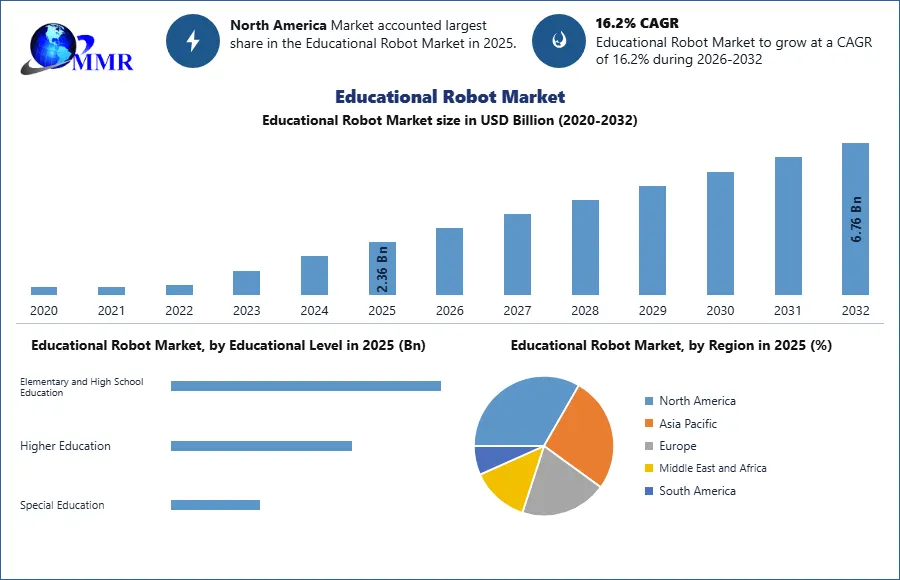
Capital Pool Expansion: The Global Educational Robot Market was valued at USD 2.36 Billion in 2025 and is projected to reach USD 6.76 Billion by 2032.
-
Sustained Growth Velocity: The sector is demonstrating a Compound Annual Growth Rate (CAGR) of 16.2% over the 2026–2032 forecast horizon.
-
Component Primacy: The Hardware segment held the dominant market share in 2025, driven by massive institutional procurement of physical sensor arrays, structural chassis, and mechanical actuators.
-
Functional Architecture: The Service Robots segment is projected to secure the absolute majority of global market volume by 2032, expanding across both K-12 and university tiers.
-
Geographic Engine: Leading technological nations including the United States, China, Japan, South Korea, and Germany continue to anchor core demand due to dense EdTech capital pools.
Why This Matters Now
The global educational framework is facing a critical turning point: industries are modernizing via artificial intelligence and advanced automation far faster than academic institutions can produce qualified engineering talent. Traditional computer labs utilizing static screens cannot teach the spatial, kinesthetic, and physical debugging skills required to manage enterprise edge computing environments, collaborative assembly systems, or automated medical logistics.
What changed? The convergence of low-cost edge processing, modular internet of things (IoT) infrastructure, and advanced voice recognition software. Why now? Because public and private training centers must immediately deliver hands-on, high-density STEM competencies to prevent structural talent shortages in automated fields. Who benefits? Early-adopter academic institutions building advanced engineering pipelines, cloud providers hosting AI training simulations, and modular hardware vendors. What happens next? A major shift from passive screen-based learning toward interactive, physical machine environments where students build, script, and troubleshoot physical AI agents.
Market Overview
The Global Educational Robot Market size is experiencing an aggressive capital deployment wave. From an investment baseline of USD 2.36 Billion in 2025, the global market is on track to hit USD 6.76 Billion by 2032. This long-term expansion is supported by a steady 16.2% CAGR from 2026 to 2032.
This structural rise represents a massive shift in how public school systems, research universities, and enterprise vocational centers allocate their technology budgets. Rather than purchasing standalone software or generic desktop computers, buyers are investing in integrated hardware-software platforms that blend cloud computing capabilities, specialized machine learning nodes, and interactive physical devices.
Key Trends Driving Growth
The primary catalyst driving this market is the deep integration of advanced artificial intelligence, machine learning pipelines, IoT protocols, and speech recognition engines directly into classroom hardware. Modern educational robots are no longer simple pre-programmed toys; they are sophisticated edge devices capable of real-time environmental processing and interactive speech feedback. This allows the technology to adapt directly to the learning speed of individual students, providing immediate feedback and customized tasks that optimize STEM skill acquisition.
Concurrently, there is an explosive increase in the use of specialized humanoid companion systems to support inclusive practices and special education frameworks. Through targeted Individualized Education Programs (IEPs), humanoid platforms are achieving exceptional outcomes with students facing autism, speech delays, or emotional and behavioral challenges. These robotic platforms create a predictable, low-stress, and hyper-consistent environment where students can master vital social, communicative, and cognitive tasks without the anxiety that often accompanies traditional group instruction.
Segment Insights
-
Hardware [Dominant Component Segment]: Holding the largest market share in 2025, the hardware vertical includes vital physical parts like electronic sensors, motor actuators, power delivery blocks, and on-board control systems. The high cost of specialized precision mechanical components keeps this segment at the top of market revenue share.
-
Service Robots [Dominant Product Type]: Projected to maintain the largest market share through 2032, this segment covers both humanoid and non-humanoid systems built to guide students and researchers through hands-on coding and advanced technical experimentation.
-
Software [Fastest-Growing Component Segment]: While physical components generate the most immediate revenue, software is expanding at the fastest growth velocity. This acceleration is driven by university laboratories and corporate training providers investing in advanced robotic operating systems, cloud-native simulation platforms, and modular programming interfaces.
-
Humanoid Robots [Fastest-Growing Product Segment]: Driven by rapid hardware development cycles from specialized firms, human-looking robots are thriving across medical training, advanced university research labs, and early-childhood learning centers.
Regional Growth Story
The United States continues to hold a leading position in the global market, backed by strong regional vendors, flexible educational policies, and an aggressive national focus on activity-based learning. U.S. school districts and higher education networks are actively modernizing their infrastructure, building specialized robotics hubs designed to expose K-12 and university students directly to collaborative automation technologies.
Meanwhile, the Asia-Pacific region is experiencing massive volume growth, led by heavy tech investments in China, Japan, and South Korea. These nations feature highly integrated technology ecosystems and large student populations, creating an ideal environment for large-scale deployments of programmable hardware. South Korea and Japan, in particular, are leveraging their deep national robotics expertise to place interactive teaching assistance tools directly into early education environments.
Competitive Landscape
The competitive environment of the global educational robot market features an intense technology race among industrial automation giants, dedicated EdTech suppliers, and specialized service robotics providers. Industry leaders like ABB Ltd., FANUC Corporation, Yaskawa Electric Corporation, KUKA AG, and Universal Robots A/S are leveraging their heavy industrial market share to build dedicated educational programs. By placing smaller, cost-effective versions of their factory-floor collaborative arms into high schools and community colleges, these firms ensure that graduating students enter the workforce fully certified on their proprietary operating platforms.
At the same time, specialized EdTech and service robotics firms like SoftBank Robotics Group Corp., ROBOTIS Co., Ltd., Robolink, PAL Robotics, and Hanson Robotics Ltd. are capturing high-margin opportunities in interactive learning. These companies focus heavily on software flexibility, building open-source, easily customized code bases that allow university researchers to quickly share and deploy new robotic behaviors across completely different physical models. This ecosystem focus shifts the competitive advantage away from pure mechanical hardware design and directly toward open software platforms, custom API options, and easy cloud connectivity.
Recent Developments
-
University Collaborative Lab Networks: Major industrial robotics providers established dedicated affiliate training facilities across community college networks, giving student engineers direct experience with high-accuracy collaborative automation systems.
-
Cross-Model Code Deployment: Academic research labs successfully demonstrated new software solutions that allow robotic code to run seamlessly across completely different humanoid platforms, reducing software fragmentation.
-
Inclusive Special Education Initiatives: Humanoid platforms like SoftBank’s NAO expanded their footprint in early-stage classrooms, delivering interactive learning modules tailored specifically for children with autism and sensory-processing differences.
-
Simulation-to-Reality Training Pipelines: Software developers launched advanced, physics-based simulation environments that allow schools to deliver remote, cloud-based programming classes when physical hardware access is limited.
Strategic Implications
Deploying modern robotics systems transforms how educational institutions design their technical training programs. For academic technology buyers and school administrators, maintaining outdated computer labs with no physical interaction elements creates an immediate risk of student disengagement and falling behind modern workforce demands. Deploy Modular Hardware Ecosystems-Procurement and Setup.Acquire scalable robotic platforms equipped with open API architectures, flexible sensor configurations, and reliable motor controllers.Embed Unified Cloud Programming Stacks-Software Integration.Connect physical classroom devices to cloud-native simulation platforms and visual coding software to support easy troubleshooting.Execute Industry-Certified STEM Pipelines-Workforce Alignment.Run structured learning paths that directly mirror real-world industrial automation, edge computing, and smart manufacturing tasks.
This structural transition completely alters the procurement strategy for modern academic institutions. The high upfront cost of advanced humanoid and collaborative hardware means that buyers must look past initial purchase prices and focus on long-term hardware durability, software upgrade options, and ecosystem support. Schools that partner directly with major automation vendors and cloud providers can secure reliable, long-term training paths that maximize student career readiness.
Future Outlook
As edge computing power and machine learning tools continue to advance, educational robotics will move from a specialized weekly lab activity to an everyday classroom asset. The traditional boundaries dividing industrial manufacturing, software engineering, and classic academic study will fade as interactive, intelligent machines become standard tools across all levels of education. This shift will create a distinct divide between future digital leaders—who use physical robotic platforms to build an agile, automation-ready workforce—and laggards left behind with outdated, purely text-based training models.
Analyst Perspective
“The capital moving into the educational robot space is a direct response to the global widening of the skills gap. Academic institutions can no longer rely on static screens to prepare students for an automated, software-driven industrial economy; hands-on interaction with intelligent edge hardware is now a baseline requirement.” — Yash Ghosalkar
About Maximize Market Research
Maximize Market Research Pvt. Ltd. (MMR) is a global market research and consulting firm known for delivering accurate, actionable, and data-driven insights. Our expertise spans diverse industries — including medical devices, pharmaceuticals, technology, automotive, electronics, chemicals, personal care, and consumer goods. We provide services such as market-validated forecasts, competitive intelligence, strategic consulting, and industry impact analysis, helping businesses navigate market complexities and achieve sustainable growth.
2nd Floor, Navale IT Park Phase 3
Pune Banglore Highway, Narhe
Pune, Maharashtra 411041, India
+91 9607365656
[email protected]