E-Waste Management Market: Global Enterprise Tech and Infrastructure Transformation Assessment

Key Highlights
-
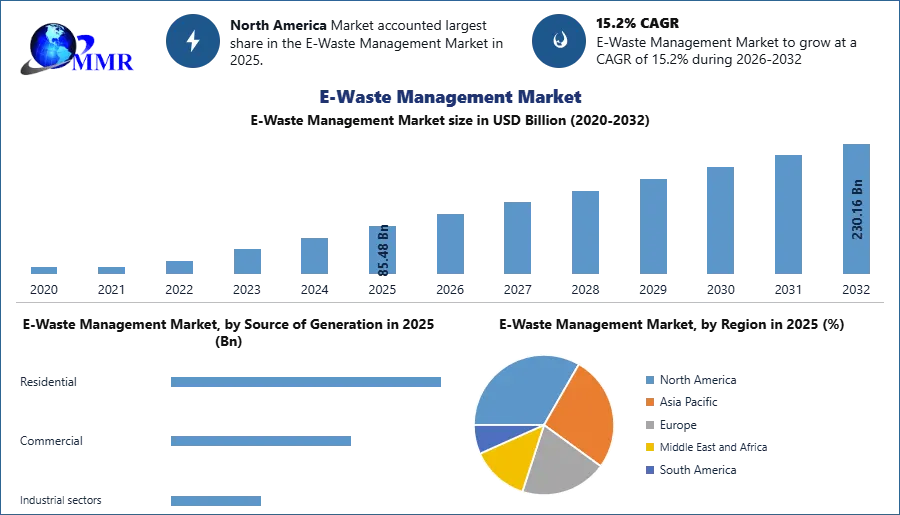
The global E-Waste Management Market achieved a valuation of USD 85.48 billion in 2025 and is forecasted to hit USD 230.16 billion by 2032.
-
Market growth accelerates at an institutional compound annual growth rate (CAGR) of 15.2% over the 2026–2032 forecast window.
-
Global production of electronic waste hit 53.6 million metric tons in 2025, driven by rapid hardware lifecycle truncation.
-
Core regulatory catalysts include the European Union’s Waste Electrical and Electronic Equipment (WEEE) Directive and the United States Secure E-Waste Export and Recycling Act.
-
Technology integration has introduced automated robotic dismantling architectures and advanced magnetic and electrostatic separation techniques.
Why This Matters Now
Corporate technology lifecycles are shrinking at an unprecedented rate, forcing enterprise CIOs, hyper-scale cloud operators, and telecom networks to confront a massive spike in discarded hardware. The global generation of electronic waste reached 53.6 million metric tons in 2025, transforming IT asset disposition from a back-office compliance routine into a high-stakes operational priority. For technology procurement officers and global infrastructure investors, this volume shift creates an urgent requirement for standardized, secure, and verifiable recovery workflows.
Improper handling of obsolete assets exposes organizations to severe regulatory fines and hazardous chemical liabilities from lead, mercury, and cadmium contamination. At the same time, the volatile pricing of industrial raw materials makes the recovery of localized precious metals from printed circuit boards a strategic alternative to primary mining. Enterprises that fail to build closed-loop recycling networks face escalating supply chain constraints and widening corporate compliance vulnerabilities.
Market Overview
The global E-Waste Management Market size was valued at USD 85.48 billion in 2025 and is structurally positioned to reach USD 230.16 billion by 2032, advancing at a compound annual growth rate (CAGR) of 15.2% from 2026 to 2032. This sector encompasses the systematic aggregation, logistics, toxic hazard mitigation, and industrial processing of decommissioned computing infrastructure, telecom machinery, and consumer electronics. Industry participants operate within strict regulatory frameworks designed to channel hazardous components away from municipal landfills and directly into certified downstream secondary commodity pipelines.
High administrative setup costs, insufficient regional sorting infrastructure, and a persistent informal extraction sector present significant operational headwinds to formal market expansion. Transporting high-volume, low-density electronic scrap over long distances erodes the margins of processing facilities, especially in developing markets that lack concentrated regional drop-off centers. Despite these infrastructure imbalances, institutional capital injections and automated processing advances are scaling up the volume capacities of certified commercial recyclers.
Key Trends Driving Growth
Industrial automated sorting and robotic dismantling systems are fundamentally altering the cost structure of high-throughput e-waste processing lines. Traditional hand-dismantling lines are being replaced by automated optical, magnetic, and electrostatic separation machinery capable of processing multi-ton batches of mixed electronic scrap per hour. These advanced extraction arrays allow facilities to isolate high-value scrap variants with minimal human intervention, maximizing processing margins while protecting laborers from toxic component exposure.
A second structural driver is the rapid transition of Fortune 500 enterprises toward formal circular economy models, shifting procurement goals from basic disposal to complete asset lifecycle tracking. Large tech operators are establishing dedicated buy-back, refurbishment, and remarketing networks to capture residual hardware value before final material destruction. This systemic framework is supported by localized corporate social responsibility mandates and enterprise e-waste collection campaigns, such as the cross-municipality recovery alliances engineered by ABC Corporation.
Segment Insights
-
Dominant Segment: Information Technology and Telecommunications Infrastructure remains the dominant source of generation segment, contributing the highest volume of high-grade printed circuit boards and core network arrays to commercial processing facilities. This dominance is sustained by continuous enterprise data center expansions, corporate server refreshes, and the systematic decommissioning of old legacy telecom nodes.
-
Fastest-Growing Segment: Automated Mechanical Recycling Processes represent the fastest-growing recycling process segment, expanding rapidly as operators replace manual labor with synchronized multi-tier shredding and electrostatic separation technologies to handle complex multi-material product designs.
Regional Growth Story
The European Union maintains an advanced position in compliance infrastructure, dictated by the strict statutory evolution of its Waste Electrical and Electronic Equipment (WEEE) Directive. This comprehensive regulatory framework shifts the financial burden of recycling directly onto hardware manufacturers, creating a self-sustaining corporate funding model for regional drop-off networks. This clear legal mandate has spurred significant private investments in automated separation infrastructure across Germany, France, and neighboring European industrial hubs.
In the United States, market expansion is heavily driven by strict federal oversight designed to eliminate unmonitored toxic exports, reinforced by the Secure E-Waste Export and Recycling Act. This legislation forces domestic enterprises to rely on certified domestic IT asset disposition partners, accelerating the growth of local processing plants. Meanwhile, major technology hubs across China and India are seeing massive infrastructure build-outs to replace informal processing yards with fully permitted, automated recovery facilities.
Competitive Landscape
The global competitive ecosystem is consolidating rapidly as scale operators invest heavily in advanced mechanical refining equipment to secure high-volume corporate processing contracts. Leading players, including Enviro-Hub Holdings Ltd., are expanding their regional logistics footprints to offer end-to-end, traceable chain-of-custody documentation to international enterprise clients. Industry positioning is increasingly determined by a provider’s verified material recovery yields and their ability to comply with cross-border transport regulations.
Operational competitive advantage has shifted toward companies that can deliver clean, factory-ready secondary commodities, such as high-purity copper, gold, and plastic polymers, directly back to original equipment manufacturers. To protect their market share against low-cost, unpermitted operators, dominant firms are forming deep technical partnerships with environmental regulators and non-governmental organizations. These strategic ecosystems ensure a steady stream of high-volume scrap feedstocks while raising compliance barriers for uncertified competitors.
Recent Developments
-
European enforcement agencies expanded the statutory collection targets within the WEEE directive, raising minimum processing thresholds for consumer electronics and computing infrastructure.
-
The United States Environmental Protection Agency expanded its national “e-Cycle” campaign, distributing targeted infrastructure grants to accelerate municipal electronics collection and sorting capabilities.
-
Global electronics manufacturer Apple increased its direct capital investments in specialized robotic dismantling engineering and public e-waste education initiatives to optimize its closed-loop manufacturing supply chains.
-
Commercial electronics operator ABC Corporation deployed a nationwide e-waste collection campaign, integrating municipal networks and regional non-governmental organizations to increase processing volumes.
Strategic Implications
For enterprise technology executives, cloud providers, and infrastructure investors, the institutionalization of e-waste management alters capital deployment and risk mitigation frameworks.
Future Outlook
The global e-waste management market is entering a phase of intense industrial optimization where manual, unmonitored extraction methods will be completely pushed out by heavily regulated, automated capital infrastructure. As cross-border waste transport laws tighten under international environmental treaties, processing facilities will consolidate near major metropolitan and technology manufacturing hubs to minimize logistics friction. This shift will reward high-scale operators who possess the processing efficiency to run profitable extraction operations on lower-grade electronic scrap amalgams. Ultimately, this structural evolution will establish a permanent operational divide that separates future digital leaders who extract clean, closed-loop value from their technology investments from laggards who face mounting compliance fines and unmitigated hardware disposal liabilities.
Analyst Perspective
“The massive scaling of enterprise data centers and corporate technology deployments has turned electronic waste management from a basic compliance box into a critical component of supply chain resilience,” – Yash Ghosalkar