
Virtual Reality (VR) technology enables users to experience computer-generated environments through immersive visual, audio, and interactive simulations. The technology creates realistic digital experiences by combining advanced hardware, software platforms, motion tracking, and spatial computing capabilities. VR solutions are increasingly being adopted across industries such as healthcare, education, gaming, aerospace & defense, automotive, manufacturing, and enterprise training due to their ability to improve visualization, collaboration, and learning experiences.
Market Overview
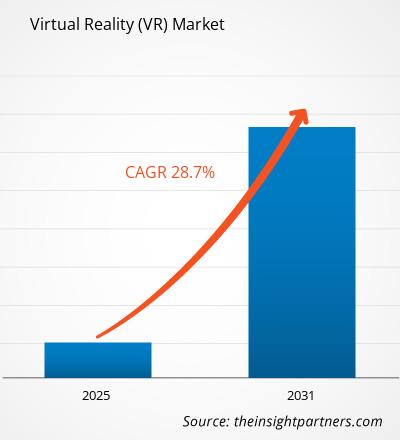
The Virtual Reality (VR) Market was valued at US$ 89.52 Billion in 2024 and is projected to reach US$ 537.98 Billion by 2031, registering a CAGR of 29.2% during the forecast period 2025–2031. The market growth is driven by increasing adoption of VR head-mounted displays (HMDs), rising demand for immersive gaming experiences, expanding healthcare applications, growing enterprise training requirements, and continuous advancements in VR hardware and software technologies.
The increasing availability of high-speed 5G networks, artificial intelligence integration, improved display technologies, and advanced motion tracking solutions are further accelerating the adoption of VR platforms across consumer and commercial applications.
Key Market Insights
- Market Size (2024): US$ 89.52 Billion
- Forecast Market Size (2031): US$ 537.98 Billion
- CAGR (2025–2031): 29.2%
- Key Growth Driver: Expanding applications of virtual reality across healthcare, gaming, education, and industrial sectors
- Major Trend: Increasing adoption of VR head-mounted displays and immersive enterprise solutions
- Forecast Period: 2025–2031
Get a Sample PDF of the Report: https://www.theinsightpartners.com/sample/TIPTE100000351
Market Drivers
Increasing Adoption of VR Head-Mounted Displays Across Industries
The growing demand for head-mounted displays (HMDs) is significantly contributing to Virtual Reality (VR) Market growth. VR headsets are being increasingly used across consumer and enterprise applications, including gaming, healthcare training, aerospace simulations, military exercises, and industrial workforce development.
Manufacturers are focusing on developing lightweight, wireless, and high-resolution HMD solutions to improve user comfort and deliver enhanced immersive experiences. The expansion of VR gaming communities and increasing consumer interest in interactive entertainment are further supporting market growth.
Growing Demand for Healthcare and Training Applications
Healthcare organizations are increasingly adopting VR technology for medical education, surgical simulations, rehabilitation programs, and patient therapy. VR-based solutions allow healthcare professionals to practice complex procedures in realistic environments while reducing operational risks.
Industries such as automotive, aerospace, defense, and manufacturing are also utilizing VR platforms for employee training, equipment simulation, and safety improvement. The ability of VR technology to provide cost-effective and risk-free training environments is driving adoption across multiple sectors.
Advancements in 5G and Immersive Technologies
The expansion of 5G networks is improving VR experiences by enabling low-latency connectivity and faster data transmission. These advancements are supporting cloud-based VR platforms, multiplayer gaming environments, and real-time enterprise applications.
Artificial intelligence, spatial computing, and advanced graphics technologies are further enhancing VR capabilities by improving interaction, personalization, and realism.
Market Trends
Integration of AI and Spatial Computing in VR Solutions
AI-powered VR platforms are becoming an important trend as companies focus on creating intelligent and personalized immersive experiences. AI integration enables improved object recognition, user interaction, predictive analytics, and adaptive virtual environments.
Expansion of Enterprise VR Applications
Businesses are increasingly adopting VR for virtual collaboration, product development, remote assistance, and workforce training. The adoption of VR beyond gaming and entertainment is creating new growth opportunities across industrial and commercial sectors.
Development of Advanced VR Hardware Ecosystems
Market players are investing in next-generation VR devices with improved display resolution, reduced latency, enhanced tracking capabilities, and improved user comfort. Strategic partnerships between hardware manufacturers and software developers are strengthening VR ecosystems.
Get the Premium Research Report @ https://www.theinsightpartners.com/buy/TIPTE100000351
Regional Analysis
North America
North America represents a key region in the Virtual Reality (VR) Market, supported by strong technology adoption, advanced research capabilities, and increasing investments in immersive solutions. The United States is a major contributor due to expanding VR applications across gaming, healthcare, defense, education, and enterprise training.
The presence of leading technology companies and growing demand for advanced VR hardware and software solutions continue supporting regional market growth.
Europe
Europe is witnessing increasing adoption of VR technology across healthcare, automotive, education, manufacturing, and industrial training applications. Countries such as Germany, the UK, and France are investing in immersive technologies to improve digital transformation initiatives and workforce development.
The growing focus on simulation-based learning and enterprise collaboration solutions is expected to create new opportunities for VR providers across the region.
Asia-Pacific
Asia-Pacific is expected to experience significant growth due to increasing investments in consumer electronics, gaming technologies, healthcare innovation, and digital transformation initiatives. Countries including China, Japan, South Korea, and India are adopting VR solutions across multiple industries.
The expansion of internet connectivity, rising smartphone penetration, and growing interest in immersive entertainment are further contributing to regional market expansion.
Middle East and Africa
The Middle East and Africa region is gradually adopting VR solutions across education, tourism, healthcare, defense, and industrial sectors. Investments in smart city initiatives and digital transformation programs are creating opportunities for VR technology providers.
Segment Analysis
By Component
The Virtual Reality (VR) ecosystem includes hardware, software, and services. Hardware components such as head-mounted displays, sensors, controllers, and tracking systems continue to represent a significant segment due to increasing demand for advanced immersive devices.
By Application
Gaming and entertainment remain major application areas for VR adoption. However, healthcare, education, aerospace & defense, automotive, manufacturing, and enterprise applications are witnessing increasing adoption due to the benefits of simulation-based learning and virtual collaboration.
Competitive Landscape
The Virtual Reality (VR) Market is highly competitive, with technology companies focusing on product innovation, strategic partnerships, and ecosystem development. Market participants are investing in advanced VR hardware, software platforms, AI integration, and immersive content solutions to strengthen their market position.
Companies are focusing on improving display technologies, reducing device costs, enhancing user experience, and expanding VR applications beyond gaming. Collaborations between hardware manufacturers, software developers, and industry solution providers are accelerating innovation across the VR ecosystem.
Key Players
- Alphabet Inc.
- Barco NV
- CyberGlove Systems, Inc.
- Meta Platforms Inc.
- HTC Corporation
- Microsoft Corporation
- Samsung Electronics Co., Ltd.
- Sensics, Inc.
- Sixense Enterprises, Inc. (Penumbra, Inc.)
- Ultraleap Ltd.
Emerging Trends
The Virtual Reality (VR) industry is evolving through advancements in artificial intelligence, extended reality integration, cloud-based VR platforms, spatial computing, wireless headsets, and immersive content development. Companies are focusing on creating more realistic, interactive, and accessible VR experiences for consumers and enterprises.
The adoption of VR in healthcare simulations, industrial training, virtual tourism, remote collaboration, and education is expected to expand significantly. Improved hardware performance, reduced costs, and enhanced software capabilities will continue creating new opportunities throughout the forecast period.
Future Outlook
The future outlook for the Virtual Reality (VR) Market remains highly positive as industries continue adopting immersive technologies to improve engagement, productivity, and operational efficiency. Growing investments in VR hardware, AI-powered applications, enterprise solutions, and digital experiences are expected to support strong market growth through 2031.
With increasing adoption across healthcare, gaming, education, manufacturing, and enterprise environments, Virtual Reality (VR) is expected to become a major technology shaping the future of human interaction with digital environments.
Related Market Research Reports
Connected Toys Market Demand, Size & Forecast by 2034
Lead Type Capacitors Market Size, Share & Demand by 2034
Remote Monitoring and Control Market Size, Trends & Demand by 2034
Nano-electromechanical Devices and Equipment Market Size, Share & Growth by 2034
About The Insight Partners
The Insight Partners is a global market research and consulting firm providing comprehensive market intelligence across technology, automotive, electronics, industrial, healthcare, and energy sectors. The company delivers actionable insights to help organizations identify opportunities, understand market trends, and make strategic business decisions.
Contact Us
- Contact Person: Ankit Mathur
- E-mail:[email protected]
- Phone: +1-646-491-9876
Also Available in :