
The global air scrubber market is experiencing substantial momentum driven by increasing industrialization, stringent environmental regulations on emissions, and heightened awareness surrounding indoor and outdoor air quality.
Air scrubbers play a critical role in controlling air pollution across various industrial and commercial operations. By removing particulates, harmful gases, acidic vapors, and chemical pollutants from industrial exhaust streams, these systems enable manufacturing plants, processing facilities, and commercial buildings to maintain safety standards and meet strict government emission mandates.
Get a PDF Sample- https://www.theinsightpartners.com/sample/TIPRE00008788
Key Drivers Accelerating Market Growth
-
Tightening Environmental Regulations: Governments and environmental protection agencies worldwide are introducing rigorous standards on industrial emissions. Mandates targeting sulfur dioxide, nitrogen oxides, volatile organic compounds (VOCs), and particulate matter compel industrial facilities to install advanced scrubbing technologies.
-
Expansion of Manufacturing and Chemical Sectors: Rapid expansion in the chemical processing, petrochemical, pharmaceutical, energy, and mining industries has heightened the demand for reliable exhaust control systems capable of handling corrosive and toxic gases.
-
Rising Demand for Indoor Air Quality (IAQ): Beyond heavy industrial applications, portable and commercial air scrubbers are seeing surging adoption in construction, remediation, healthcare, and commercial real estate to purify indoor environments from dust, mold spores, pathogens, and hazardous fumes.
Market Forecast
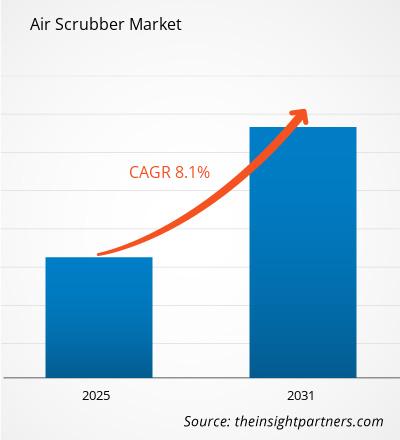
According to comprehensive market intelligence, the Air Scrubber Market is projected to grow from US$ 4.57 Billion in 2025 to US$ 8.49 Billion by 2034, registering a CAGR of 7.12% during the forecast period of 2026–2034.
Market Segmentation & Technology Trends
The air scrubber market is typically segmented by type, technology, application, and geography:
-
By Product Type: Wet air scrubbers and dry air scrubbers represent the primary categories. Wet scrubbers remain widely utilized due to their high efficiency in removing both particulates and soluble gases simultaneously. Meanwhile, dry scrubbers are gaining traction in applications where water usage, liquid disposal, or corrosion are major concerns.
-
By Technology: Systems are categorized into packed-bed scrubbers, venturi scrubbers, spray towers, cyclonic scrubbers, and catalytic scrubbers. Venturi scrubbers are favored for high-temperature applications and fine particulate removal, whereas packed-bed systems dominate gas absorption applications.
-
By End-Use Industry: Key application sectors include chemical manufacturing, oil & gas, power generation, wastewater treatment, pharmaceuticals, food & beverage, and construction/remediation.
Competitive Landscape: Key Market Players
The market features a mix of globally established engineering firms and specialized environmental control solution providers focusing on technological innovation, custom fabrication, and energy-efficient scrubbers.
Prominent market participants include:
-
CECO Environmental Corp.
-
Ducon Environmental Systems Inc.
-
Babcock & Wilcox Enterprises, Inc.
-
Evoqua Water Technologies LLC
-
Anguil Environmental Systems, Inc.
-
Pollution Systems
-
Tri-Mer Corporation
-
Monroe Environmental Corp.
-
Verantis Environmental Solutions Group
-
Airex Industries Inc.
These key players are actively investing in research and development to manufacture multi-stage scrubbing systems, energy-saving designs, and automated control technologies that offer real-time monitoring and reduced operational costs. Strategic partnerships, mergers, and regional expansions remain core strategy pillars for these major players aiming to consolidate their global footprints.
Get Full Copy of This Report- https://www.theinsightpartners.com/buy/TIPRE00008788
Regional Insights
-
North America: Holds a prominent market share due to mature industrial infrastructure, stringent EPA (Environmental Protection Agency) regulations, and high adoption of advanced pollution control equipment.
-
Europe: Driven by ambitious European Union sustainability goals, strict carbon and toxic emission caps, and a strong presence of chemical and manufacturing hubs.
-
Asia-Pacific: Anticipated to showcase the highest growth rate during the forecast period. Rapid urbanization, accelerating industrialization in developing economies (such as China, India, and Southeast Asian nations), and newly introduced environmental compliance policies are propelling massive regional demand.
Future Outlook
The future of the global air scrubber market looks highly promising as industrial operations shift toward sustainable production and eco-friendly infrastructure. Over the coming decade, market developments will likely focus on smart air scrubbing systems integrated with IoT sensors, AI-driven predictive maintenance, and energy-efficient designs that reduce total cost of ownership. As global commitments to zero-emission goals intensify and regional governments enforce stricter non-compliance penalties, the integration of advanced wet and dry scrubbing solutions will become a standard operational requirement rather than an elective upgrade. Expanding from US$ 4.57 Billion in 2025 to US$ 8.49 Billion by 2034, the air scrubber market stands as a critical pillar in the global transition toward cleaner industrial air and safer working environments.