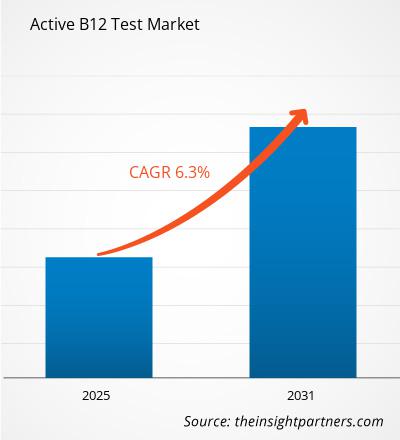

According to The Insight Partners, Global Active B12 Test Market is projected to reach US$ 251.5 million by 2034, growing from US$ 182.25 million in 2025, at a CAGR of 3.64% during the forecast period of 2026–2034. The market is experiencing steady expansion due to increasing awareness regarding vitamin B12 deficiency, rising demand for accurate diagnostic solutions, and growing emphasis on preventive healthcare worldwide. Active B12 testing has become an essential diagnostic tool because it measures holotranscobalamin—the biologically active fraction of vitamin B12—which provides more accurate and earlier detection of deficiency compared to conventional serum vitamin B12 tests.
Vitamin B12 deficiency has emerged as a significant global health concern, particularly among older adults, pregnant women, vegetarians, vegans, and patients suffering from gastrointestinal disorders. Since vitamin B12 plays a crucial role in neurological function, red blood cell formation, and DNA synthesis, early diagnosis has become increasingly important for preventing irreversible health complications. Healthcare professionals are gradually shifting toward active B12 testing as it enables earlier intervention and improved patient outcomes.
Get a Sample PDF – https://www.theinsightpartners.com/sample/TIPRE00017671
The growing incidence of chronic diseases further supports the expansion of the Active B12 Test Market. Conditions such as diabetes, gastrointestinal diseases, autoimmune disorders, and chronic kidney disease often interfere with vitamin B12 absorption. Additionally, long-term use of medications including metformin and proton pump inhibitors has been associated with vitamin B12 deficiency, increasing the need for routine monitoring through reliable diagnostic methods.
Technological advancements in laboratory diagnostics have significantly improved the efficiency and reliability of active B12 testing. Automated immunoassay platforms, enhanced assay sensitivity, and standardized testing protocols enable laboratories to deliver faster and more accurate results. Modern diagnostic instruments also reduce turnaround time while supporting high-volume testing, making active B12 assays suitable for hospitals, diagnostic laboratories, and specialized testing centers.
Increasing healthcare expenditure across developed and emerging economies is another important factor driving market growth. Governments and healthcare organizations are investing in preventive medicine and early disease detection programs to reduce long-term healthcare costs. As awareness campaigns educate physicians and patients about the importance of identifying vitamin B12 deficiency before clinical symptoms become severe, demand for active B12 testing continues to rise.
The aging global population represents another major growth driver. Older adults frequently experience reduced vitamin B12 absorption due to age-related physiological changes, making routine screening increasingly necessary. Early diagnosis allows healthcare providers to implement timely treatment strategies that reduce complications associated with cognitive decline, anemia, neuropathy, and other health conditions related to vitamin B12 deficiency.
Segmentation Analysis
By Diagnosis
The diagnosis segment is anticipated to register steady growth during the forecast period, driven by the increasing adoption of advanced diagnostic techniques for evaluating vitamin B12 deficiency. Healthcare providers are prioritizing testing methods that offer high sensitivity, accuracy, rapid turnaround times, and seamless integration into routine laboratory workflows. While ELISA-based testing continues to serve specialized applications, automated enzyme immunoassay platforms are witnessing broader adoption due to their operational efficiency and standardized performance.
- ELISA Assay: ELISA assays continue to play an important role in specialized diagnostic laboratories, research institutions, and regional testing centers where batch processing, cost efficiency, and flexible sample handling remain key advantages.
- Enzyme Immunoassay: Enzyme immunoassays represent the preferred choice for routine clinical testing, supported by automated platforms that enhance laboratory productivity, minimize manual intervention, improve throughput, and ensure consistent analytical performance.
By Indication
The indication segment is expected to expand steadily as awareness of vitamin B12 deficiency and its associated clinical complications continues to increase. Active B12 testing provides valuable clinical information for differentiating deficiency-related disorders, particularly when conventional biomarkers produce inconclusive results. Rising cases of anemia and neurological disorders are further supporting market demand.
- Folate Deficiency Anemia: Active B12 testing assists clinicians in distinguishing folate deficiency from vitamin B12 deficiency, as both conditions often present with similar hematological abnormalities but require different treatment approaches.
- Pernicious Anemia: This segment remains significant due to the autoimmune nature of the disease, which impairs vitamin B12 absorption and necessitates accurate diagnosis, continuous monitoring, and appropriate therapeutic management.
- Macrocytic Anemia: Increasing evaluation of macrocytic anemia is driving demand for active B12 testing, enabling clinicians to assess vitamin B12 deficiency alongside other potential causes such as liver disease, medication use, alcohol consumption, and bone marrow disorders.
By End User
The end-user segment is witnessing sustained growth as healthcare institutions increasingly adopt active B12 testing to improve diagnostic accuracy and patient management. Hospitals, medical laboratories, and research organizations each contribute to market expansion through growing testing volumes and broader clinical applications.
- Hospitals: Hospitals account for a significant share of testing demand by utilizing active B12 assays in the diagnosis and management of anemia, neurological disorders, pregnancy-related deficiencies, gastrointestinal diseases, and post-bariatric surgery patients.
- Medical Laboratories: Independent and reference laboratories remain central to routine testing services by offering high-throughput diagnostic capabilities, standardized quality assurance, and efficient processing of outpatient and referral samples.
- Clinical Research Organizations (CROs): CROs are increasingly incorporating active B12 testing into nutrition research, aging studies, clinical trials, and metabolic disease investigations, supporting biomarker-driven research and precision healthcare initiatives.
Artificial intelligence and digital healthcare technologies are gradually influencing diagnostic workflows by improving laboratory efficiency, data management, and clinical interpretation. Integration of digital laboratory systems enables healthcare providers to manage patient information more effectively while supporting evidence-based clinical decision-making. Such technological developments are expected to improve operational efficiency and expand the clinical value of active B12 testing.
Despite positive growth prospects, the market faces certain challenges. Limited awareness regarding the advantages of active B12 testing over conventional vitamin B12 assays remains a barrier in some regions. Cost considerations, limited reimbursement policies in developing countries, and varying clinical practice guidelines may also restrict widespread adoption. However, continued physician education, expanding clinical evidence, and increasing investments in diagnostic innovation are expected to address these challenges over time.
Key Market Players
Leading companies operating in the Active B12 Test Market include:
Abbott Laboratories, Axis-Shield Diagnostics Limited, Siemens Healthineers AG, F. Hoffmann-La Roche Ltd, DiaSorin S.p.A., Biohit Oyj and Tecan Group Ltd for automated assays, ELISA systems, and laboratory reagents market. The niche supply capability comes from LifeSpan BioSciences, Inc., Demeditec Diagnostics GmbH, and New Stetic S.A., due to their capabilities in immunoassay, specialized kits, and regional distribution.
These companies are actively focusing on product innovation, strategic collaborations, global expansion, and continuous research and development to strengthen their market presence. Investments in advanced diagnostic technologies and laboratory automation continue to enhance testing performance while supporting growing global demand for accurate vitamin B12 deficiency diagnostics.
Get Premium Research Report Market Size and Report at:
https://www.theinsightpartners.com/buy/TIPRE00017671
Future Outlook
The Active B12 Test Market is expected to witness steady and sustainable growth through 2034 as healthcare systems increasingly prioritize preventive diagnostics and early nutritional assessment. Continuous technological innovation, expanding awareness regarding vitamin B12 deficiency, and increasing adoption of personalized medicine will create new growth opportunities. As laboratory automation, digital healthcare integration, and diagnostic accuracy continue to improve, active B12 testing is expected to become an increasingly important component of routine clinical practice worldwide.
About Us
The Insight Partners is a one stop industry research provider of actionable intelligence. We help our clients in getting solutions to their research requirements through our syndicated and consulting research services. We specialize in industries such as Semiconductor and Electronics, Aerospace and Defense, Automotive and Transportation, Biotechnology, Healthcare IT, Manufacturing and Construction, Medical Device, Technology, Media and Telecommunications, Chemicals and Materials.
Contact Us
Ankit Mathur | The Insight Partners
E-mail: [email protected]
Phone: +1-646-491-9876
Also Available in : Korean | German | Japanese | French | Chinese | Italian | Spanish