Autonomous Emergency Braking (AEB) System Market to Reach US$ 164.8 Billion by 2034, CAGR of 14.64%

The global automotive landscape is undergoing a massive transformation driven by safety regulations, electrification, and autonomous driving technology. At the center of this evolution is the Autonomous Emergency Braking (AEB) system an advanced safety feature designed to prevent collisions or lessen their severity by automatically applying the vehicle’s brakes when a threat is detected.
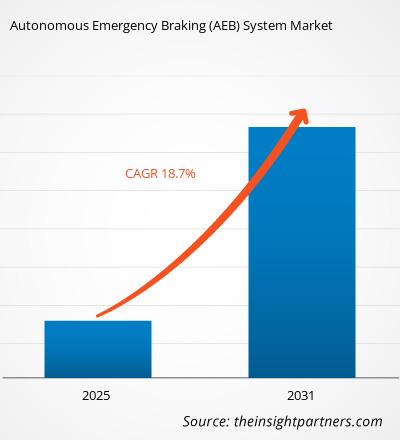
The Autonomous Emergency Braking (AEB) System Market size is expected to reach US$ 164.8 Billion by 2034 from US$ 48.2 Billion in 2025. The market is estimated to record a CAGR of 14.64% from 2026 to 2034. This notable expansion highlights the escalating integration of Advanced Driver Assistance Systems (ADAS) in both passenger and commercial vehicles globally.
Market Overview and Growth Drivers
Autonomous Emergency Braking systems utilize a network of sensors including radar, cameras, and LiDAR to monitor the road ahead and identify potentially dangerous obstacles, such as other vehicles, pedestrians, and cyclists. When the system detects an impending collision, it first alerts the driver via visual, audible, or haptic warnings. If the driver fails to respond in time, the system autonomously applies full or partial braking to prevent the impact or mitigate crash severity.
Key Factors Driving Market Expansion:
-
Mandatory Regulatory Standards: Governments and safety organizations across Europe, North America, and Asia-Pacific have introduced strict safety standards. Rating agencies such as the European New Car Assessment Programme (Euro NCAP) and the U.S. National Highway Traffic Safety Administration (NHTSA) mandate high AEB performance to award top safety ratings.
-
Rising Passenger & Commercial Safety Demands: As traffic density increases, fleet operators and personal vehicle buyers prioritize active safety features that directly lower accident risks and insurance premiums.
-
Sensor Technology Integration: Rapid advances in sensor fusion combining high-resolution cameras, millimeter-wave radar, and cost-effective LiDAR have significantly improved AEB accuracy under challenging weather and lighting conditions.
-
Growth in Autonomous Driving Development: AEB serves as a foundational building block for higher levels of automated driving (Level 2+ to Level 4). As automakers scale autonomous capabilities, AEB architecture continues to become more sophisticated.
Get a PDF Sample– https://www.theinsightpartners.com/sample/TIPRE00013117
System Classifications and Vehicle Types
AEB systems are broadly categorized into three core operational modes:
-
Forward Collision Warning (FCW): Alerts the driver to imminent collisions without intervening directly in vehicle control.
-
Dynamic Brake Support (DBS): Supplements driver braking force if the system senses that the applied pressure is insufficient to prevent an impact.
-
Crash Imminent Braking (CIB): Automatically applies brakes when the driver takes no action to avoid a critical collision.
While passenger cars currently hold a significant market share due to high production volumes and consumer demand, commercial vehicle adoption is accelerating rapidly. Regulations governing heavy-duty trucks and buses have propelled the installation of AEB solutions to protect fleet assets, reduce liability, and safeguard vulnerable road users.
Key Players Operating in the Market
The global market for AEB systems is highly competitive, driven by continuous innovation, strategic partnerships, and technological advancements from established automotive tier-1 suppliers and technology providers. Leading players featured in the market report include:
-
Autoliv, Inc. – A global pioneer in automotive safety systems, supplying advanced sensors and electronic braking integration.
-
Continental AG – Offers comprehensive safety architectures combining multi-function cameras and radar sensors for precise obstacle recognition.
-
DAF – Integrates robust active safety and emergency braking solutions into heavy commercial transport platforms.
-
Delphi Technologies – Develops specialized power electronics, propulsion, and safety solutions for vehicle architectures.
-
Hyundai Mobis Co., Ltd. – Provides integrated driver-assist systems and intelligent safety electronics tailored for passenger vehicles.
-
Mando Corporation – Focuses on chassis components and ADAS technologies, providing efficient braking and steering actuation systems.
-
Mobileye – A leader in computer vision and system-on-chip (SoC) technology powering vision-based AEB systems worldwide.
-
Robert Bosch GmbH – Delivers end-to-end active safety suites, combining sensor fusion hardware and software modules for AEB applications.
-
WABCO Holdings Inc. – Specializes in braking control systems, stability technologies, and driver assistance solutions for commercial fleets.
-
ZF Friedrichshafen AG – Supplies intelligent safety solutions, integrating camera technology, radar, and central control units across diverse vehicle segments.
Get Full Copy of This Report- https://www.theinsightpartners.com/buy/TIPRE00013117
Future Outlook
The Autonomous Emergency Braking (AEB) system market is positioned for sustained long-term growth as active safety shifts from a luxury option to a standard global automotive requirement. In the coming years, market developments will concentrate on refining pedestrian and cyclist detection algorithms, improving nighttime operation, and enhancing junction assist functionality. Furthermore, the convergence of AEB with vehicle-to-everything (V2X) communication will allow vehicles to anticipate potential hazards beyond the direct line of sight. As artificial intelligence and edge computing capabilities mature, AEB systems will achieve higher reliability, fewer false positives, and seamless integration into fully autonomous vehicle platforms, securing their essential role in the future of global mobility.
Related Reports-
Automotive Brake Adjusters Market
Commercial Vehicle Exhaust Brake Market
About Us
The Insight Partners is a one-stop industry research provider of actionable intelligence. We help our clients in getting solutions to their research requirements through our syndicated and consulting research services. We specialize in industries such as Semiconductor and Electronics, Aerospace and Defense, Automotive and Transportation, Biotechnology, Healthcare IT, Manufacturing and Construction, Medical Devices, Technology, Media, and Telecommunications, as well as chemicals and Materials.