
Key Highlights
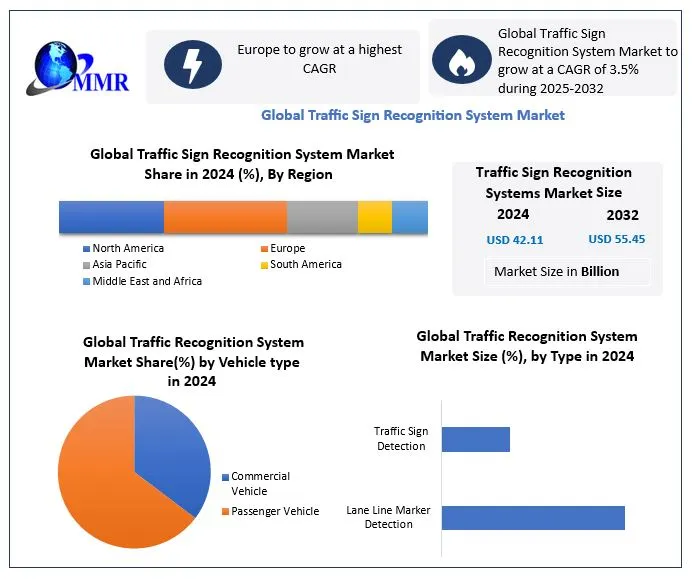
- Global Traffic Sign Recognition System Market was valued at USD 42.11 billion in 2024 and is projected to reach USD 55.45 billion by 2032, expanding at a 3.5% CAGR. Each percentage point of expansion signals broader ADAS penetration across mainstream vehicle platforms.
- Europe leads the market due to stringent vehicle safety regulations and strong automotive manufacturing capabilities. Regulatory leadership is accelerating mandatory deployment of intelligent safety systems.
- Passenger vehicles remain the dominant vehicle segment as buyers increasingly expect advanced safety technologies in standard vehicle packages.
- Artificial intelligence, image processing, and autonomous driving development continue to strengthen demand for traffic sign recognition technologies.
- Electric vehicles and emerging automotive markets are creating new commercialization opportunities for OEMs and Tier-1 suppliers.
Why This Matters Now
The automotive industry is shifting from mechanical differentiation to software-defined intelligence. Traffic Sign Recognition Systems (TSRS) have become one of the core perception technologies enabling safer driving, advanced driver assistance systems (ADAS), and future autonomous mobility.
Governments are tightening vehicle safety regulations while consumers increasingly expect intelligent driving assistance in everyday vehicles. For OEMs, suppliers, fleet operators, and investors, TSRS has become a strategic capability rather than an optional feature, supporting both regulatory compliance and competitive product positioning.
Market Overview
The Global Traffic Sign Recognition System Market reached USD 42.11 billion in 2024 and is forecast to reach USD 55.45 billion by 2032, growing at a 3.5% CAGR. The market expansion reflects growing deployment of camera-based perception systems across passenger vehicles and increasing integration of ADAS technologies. Every increase in market value represents broader installation of intelligent safety features throughout global vehicle production.
Traffic Sign Recognition Systems identify road signs through cameras and image-processing algorithms before providing alerts or assisting vehicle decision-making. Their role extends beyond driver convenience. They are becoming foundational technologies supporting semi-autonomous and autonomous driving functions.
The industry is also benefiting from rising investments in artificial intelligence and computer vision. Manufacturers increasingly integrate TSRS into comprehensive safety suites that combine lane assistance, adaptive cruise control, collision avoidance, and driver monitoring systems.
Key Trends Driving Growth
Road safety regulation has become the industry’s strongest growth catalyst. European safety mandates continue pushing OEMs to standardize advanced driver assistance technologies across new vehicle platforms. Compliance is transforming TSRS from premium equipment into a mainstream production requirement.
The expansion of connected vehicles is creating additional value. Traffic Sign Recognition Systems increasingly interact with vehicle software platforms, enabling continuous driver assistance while supporting software-defined vehicle architectures.
Electrification is opening another growth avenue. The report identifies electric vehicle integration as a significant market opportunity. As EV manufacturers compete through digital functionality rather than traditional powertrain performance, intelligent safety technologies strengthen product differentiation.
Autonomous driving development further elevates market importance. Reliable traffic sign interpretation forms one of the essential perception capabilities required for higher levels of driving automation.
The report also highlights emerging demand across developing markets in South Asia, where lower-cost TSRS solutions are expanding accessibility. This creates opportunities for suppliers capable of balancing affordability with regulatory compliance.
Segment Insights
- Dominant Segment: Passenger Vehicles — The passenger vehicle segment leads the market because consumers increasingly demand factory-installed safety technologies and ADAS capabilities. Higher production volumes also accelerate technology adoption.
- Fastest-Growing Segment: Not specified in the source report. The report identifies growing opportunities through electric vehicle integration and emerging markets but does not identify a fastest-growing market segment.
- Technology Insight: AI-powered image processing continues improving multilingual traffic sign recognition, supporting broader global deployment.
- Vehicle Technology Insight: Integration with autonomous and semi-autonomous driving platforms expands the strategic role of TSRS beyond standalone driver assistance.
Regional Growth Story
Europe remains the market leader because regulatory mandates align with strong automotive manufacturing capabilities. This combination allows European OEMs and suppliers to commercialize advanced safety technologies earlier than many competing regions. Regulatory leadership strengthens the region’s technology ecosystem while reinforcing supplier competitiveness.
North America continues investing heavily through technology companies and vehicle manufacturers including Tesla, NVIDIA, Qualcomm, Mobileye, and Ford. The region benefits from strong AI development, semiconductor innovation, and software integration capabilities supporting intelligent mobility solutions.
Asia-Pacific represents a significant production ecosystem with major manufacturers including Toyota, Hyundai, Honda, Nissan, Panasonic, Hitachi Astemo, and Tata Elxsi participating across intelligent mobility development. Growing automotive production combined with increasing ADAS adoption strengthens long-term opportunities throughout China, Japan, South Korea, and India.
Competitive Landscape
Competition is increasingly centered on software capability rather than hardware alone.
Bosch, Continental, ZF Friedrichshafen, and Valeo continue advancing AI-enabled multilingual recognition systems. Their investments indicate that future supplier leadership will depend on perception software, algorithm accuracy, and seamless integration with complete ADAS ecosystems rather than standalone camera modules.
Technology companies including Mobileye, NVIDIA, Qualcomm, and Tesla illustrate the growing convergence between automotive manufacturing and semiconductor-driven computing platforms. Their participation signals that future competitive advantage will increasingly depend on computing performance, software optimization, and scalable AI architectures.
Traditional OEMs are simultaneously strengthening internal software capabilities while collaborating with Tier-1 suppliers. This evolution is gradually reshaping supplier relationships from component sourcing toward long-term software partnerships.
Recent Developments
- Increasing deployment of AI-powered multilingual Traffic Sign Recognition modules by leading automotive suppliers.
- Rising integration of TSRS within advanced driver assistance system portfolios supporting semi-autonomous driving.
- Continued expansion of intelligent safety technologies into electric vehicle platforms.
- Growing commercialization of lower-cost TSRS solutions across developing automotive markets.
Strategic Implications
For OEM executives, TSRS is becoming a strategic differentiator supporting safety ratings, regulatory compliance, and customer value perception.
Tier-1 suppliers face increasing pressure to combine camera hardware, AI software, and semiconductor optimization into integrated perception platforms. Competitive advantage will increasingly depend on software performance and continuous system updates rather than manufacturing scale alone.
Fleet operators benefit from enhanced driver awareness and improved operational safety, while investors should monitor companies capable of combining AI expertise with scalable automotive production partnerships.
The report also indicates opportunities linked to electric vehicle integration, reinforcing the convergence between electrification and intelligent mobility development.
Future Outlook
Traffic Sign Recognition Systems are evolving from standalone ADAS functions into foundational perception technologies supporting connected, autonomous, and software-defined vehicles. Regulatory requirements, AI innovation, and expanding electric vehicle adoption will continue accelerating deployment across global automotive production.
The companies that integrate intelligent perception into scalable software platforms will define the next generation of vehicle safety, while manufacturers treating traffic sign recognition as only another compliance feature risk losing competitive relevance.
Analyst Perspective
“The Traffic Sign Recognition System Market is entering a phase where intelligent perception becomes central to vehicle safety, autonomous mobility, and connected transportation. Companies investing in AI-enabled recognition capabilities and integrated ADAS platforms will be better positioned to compete in the next generation of automotive innovation.” — Tejaswini Kakade
About Maximize Market Reserach
Maximize Market Research Pvt. Ltd. (MMR) is a global market research and consulting company that provides reliable, data-focused, and practical business insights. The firm serves a wide range of industries, including healthcare, pharmaceuticals, technology, automotive, electronics, chemicals, personal care, and consumer goods. Through market forecasts, competitive analysis, strategic consulting, and industry impact assessments, MMR helps organizations understand changing market conditions, identify growth opportunities, and make informed business decisions for long-term success.
2nd Floor, Navale IT Park Phase 3
Pune Banglore Highway, Narhe
Pune, Maharashtra 411041, India
+91 9607365656
[email protected]