
Key Highlights
-
Market Growth: Projected reach of $21.1 billion by 2033, expanding at a CAGR of 7.88%.
-
Dominant Technology: UV-curable inks lead the market share, favored for their rapid curing and high durability.
-
Primary Demand Driver: Mounting corporate and regulatory pressure to reduce single-use plastic waste via circular packaging systems.
-
Key Performance Requirement: Inks must maintain print integrity through multiple industrial washing and sterilization cycles without degrading or contaminating the glass.
-
Strategic Focus: Innovation is centered on eco-friendly, non-toxic formulations that align with global Environmental, Social, and Governance (ESG) mandates.
Why This Matters Now
The “plastic-to-glass” migration is forcing a rethink of how manufacturers identify and track assets. Unlike single-use labeling, returnable bottles require markings that survive aggressive caustic wash environments, heat sterilization, and mechanical abrasion. For industrial buyers, the failure of an ink formulation is not merely a cosmetic issue; it represents a failure of the entire returnable asset fleet. Procurement leaders must now secure high-performance ink supply chains that guarantee visual consistency and regulatory compliance, as ink performance now dictates the operational lifespan of the bottle itself.
Market Overview
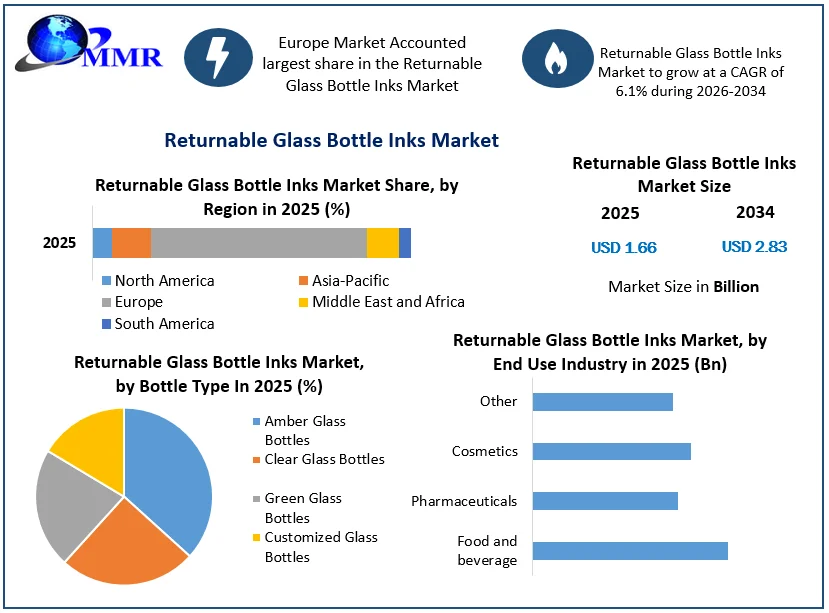
The Returnable Glass Bottle Inks Market are no longer a commodity-level purchase; they are specialized engineered materials. The market is currently valued at $11.5 billion (2026) and is climbing toward a 2033 valuation of $21.1 billion. This growth is directly linked to the beverage industry’s commitment to net-zero targets and the increasing utility of glass as an infinitely recyclable, inert, and premium-tier packaging medium. The technical challenge lies in balancing extreme durability during the “use phase” with the ability to ensure clean, residue-free surfaces for subsequent refilling.
Key Trends Driving Growth
-
Sustainability Mandates: Global regulatory frameworks are systematically tightening rules on single-use packaging, providing a structural tailwind for returnable systems.
-
Operational Efficiency: Innovations in “smart packaging” and tracking are integrating ink functionality with inventory logistics, allowing bottles to serve as data carriers within the supply chain.
-
Aesthetic Retention: Premium brands are demanding inks that resist scratching and fading to maintain brand equity, as the “look and feel” of the bottle remains the primary consumer touchpoint.
-
Regulatory Compliance: As food-safety standards evolve, there is an accelerated pivot toward low-VOC and non-toxic ink chemistries that meet international migration limits for consumer-facing goods.
Get a free sample
Segment Insights
-
Dominant Segment (Technology): UV-Curable Inks. Holding a significant share of the market, these inks are favored for their immediate curing times, chemical resistance, and ability to hold high-resolution detail across complex glass geometries.
-
Fastest-Growing Segment (Application): Beverage Packaging. Driven by massive global infrastructure investments in returnable bottle lines, the alcoholic and non-alcoholic beverage sectors remain the largest consumers of high-durability inks.
Regional Growth Story
North America currently leads the market, underpinned by an established, high-volume beverage industry and strong consumer demand for sustainable packaging in the United States. However, the Asia-Pacific region is emerging as the fastest-growing hub. Rapid expansion in the beverage industries of China and India, coupled with an increasing emphasis on modern, efficient bottling technologies, is fueling a surge in demand for specialized ink formulations. Europe continues to maintain a stable trajectory, characterized by a sophisticated circular economy infrastructure and a deep-seated cultural preference for glass over plastic in retail environments.
Competitive Landscape
The market is characterized by a high degree of technical barrier-to-entry. Competitive positioning is currently determined by the ability of ink manufacturers to partner with glass packaging giants. Recent market activity suggests that the industry is moving toward “systems-based” selling, where chemical companies provide not just the ink, but the specialized printing and curing equipment as a bundled solution. This shift signals a move toward long-term service contracts that lock in brand loyalty and create recurring revenue streams based on the volume of bottles processed.
Recent Developments
-
Lightweighting Integration: Ink developers are optimizing formulations for the new generation of lightweight glass bottles, ensuring that surface treatments do not compromise the structural integrity of thinner-walled containers.
-
High-Speed Curing: Manufacturers have deployed next-generation UV/LED curing systems that increase line speeds, allowing bottlers to reduce throughput bottlenecks without sacrificing print quality.
-
ESG-Aligned R&D: Leading firms are investing heavily in water-based and bio-derived ink resins to replace traditional solvent-heavy formulations, directly addressing the growing demand for “green-certified” packaging materials.
Strategic Implications
For investors, the opportunity lies in firms that have successfully bridged the gap between chemical expertise and high-speed industrial printing. The market is increasingly rewarding companies that can deliver “total-cost-of-ownership” improvements, such as inks that require less energy to cure or fewer washing chemicals to remove. Procurement leaders should prioritize suppliers with robust supply chain redundancies, as the high-performance pigments and resins required for these inks are susceptible to regional logistics and raw material price shocks.
Future Outlook
The returnable glass bottle ink market is evolving from a fragmented supplier landscape into an integrated component of the circular supply chain. The winners will be the chemical providers who can demonstrate the highest “wash-cycle reliability” and the lowest environmental footprint in a single, scalable ink formulation. Those who view these inks as mere commodities will lose market share to agile firms capable of delivering high-performance, mission-critical solutions for a refillable future.
Analyst Perspective: “The pivot to returnable packaging has turned the humble bottle ink into a mission-critical asset. We are no longer just measuring print quality; we are measuring the number of cycles an ink can survive in a caustic, high-pressure industrial wash. The companies that solve the durability-versatility paradox will effectively control the labeling standard for the next generation of global beverage distribution.” — Ankita Kagwade, Analyst.
About Maximize Market Research
Maximize Market Research Pvt. Ltd. (MMR) is a global market research and consulting company that provides reliable, data-focused, and practical business insights. The firm serves a wide range of industries, including healthcare, pharmaceuticals, technology, automotive, electronics, chemicals, personal care, and consumer goods. Through market forecasts, competitive analysis, strategic consulting, and industry impact assessments, MMR helps organizations understand changing market conditions, identify growth opportunities, and make informed business decisions for long-term success.
2nd Floor, Navale IT Park Phase 3
Pune Banglore Highway, Narhe
Pune, Maharashtra 411041, India
+91 9607365656
[email protected]