
Key Highlights
-
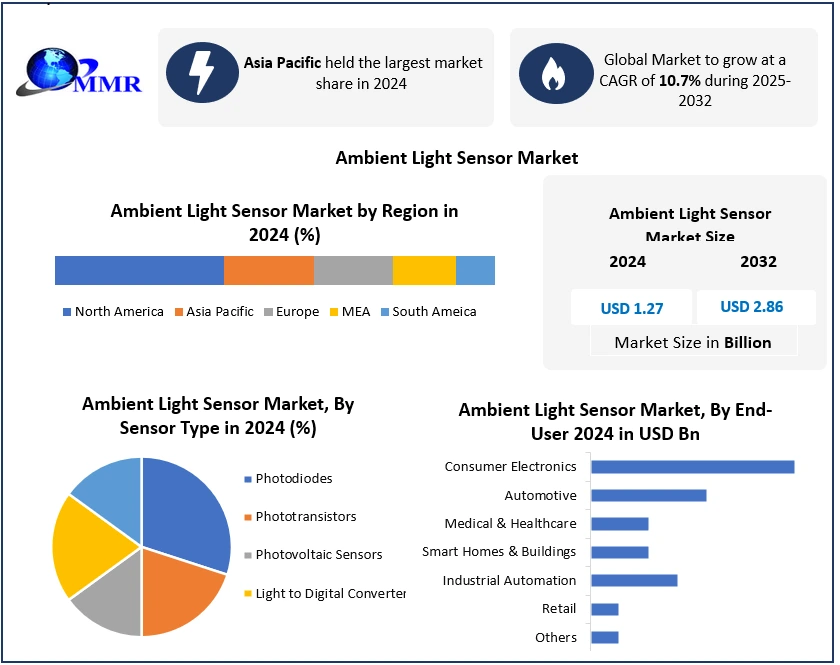
The global ambient light sensor market established a baseline valuation of US$ 850.35 million in 2020, positioning it as a core building block within modern optoelectronic supply chains.
-
Sector growth proceeds at a projected compound annual growth rate (CAGR) of 10.72%, reflecting accelerated demand across high-volume assembly lines worldwide.
-
Consumer electronics commands the dominant segment position, fueled by massive smartphone deployment and a push for display readability optimization.
-
Structural integration spans multiple adjacent verticals, including automotive dashboard layouts, retail displays, medical diagnostic equipment, and electrical controls.
-
High research and development (R&D) barriers continue to define the competitive landscape, shifting leverage toward primary system integrators and fabless developers.
Why This Matters Now
The microelectronics value chain faces a critical crossroad where display performance directly determines device battery endurance and market viability. Original equipment manufacturers (OEMs) cannot afford inefficient display power draw while attempting to deliver advanced computing features at the edge. The integration of ambient light sensors solves this foundational engineering challenge by matching screen luminance directly to localized environments.
For semiconductor foundries and fabless firms, this transition represents a permanent shift toward high-volume, precision optoelectronic hardware. As global smartphone penetration continues its upward trajectory, ambient light sensors have evolved from premium add-ons into mandatory architectural components. Entities that secure stable sensor supply chains and manage high research costs will capture systemic pricing power, while slow-moving component buyers risk immediate margin compression.
Market Overview
An Ambient light sensor Market functions by recognizing and measuring illumination levels near an object, passing data down to logical controllers to modulate screen brightness. Optoelectronic hardware acts as the primary link between physical environments and digital system responses.
This capability is essential for modern liquid crystal display (LCD) panels, where backlight management dictates total power efficiency. The global ambient light sensor market achieved a valuation of US$ 850.35 million in 2020. Moving forward, the industry expands at a compound annual growth rate of 10.72%, signaling sustained integration across advanced consumer, industrial, and automotive product platforms.
Key Trends Driving Growth
The rapid expansion of the global smart device ecosystem remains the primary catalyst for sensor deployment. As smartphone penetration accelerates across developing and developed economies, raw unit production drives unprecedented demand for low-power optoelectronic chips. Modern display architectures rely on ambient light detection to solve two distinct operational problems: mitigating battery drain caused by excessive brightness and eliminating user eye strain in dark environments.
Concurrently, display technology development introduces high-resolution LCD and organic light-emitting diode setups that require granular, real-time luminance tracking. Beyond consumer handheld electronics, the automotive sector is restructuring its interior cockpits around large central touchscreens and digital instrument clusters. These systems use ambient light sensors to guarantee instant readability during sudden external light shifts, such as entering tunnels or driving under intense direct sunlight.
Segment Insights
-
Dominant Segment: The consumer electronics vertical holds the leading market share position, maintaining its dominance throughout the projection timeframe due to systemic smartphone adoption and expanding notebook fabrication volume.
-
Fastest-Growing Segment: Industrial and automotive display systems represent a rapidly advancing area, as digital cockpits and smart retail interfaces mandate intelligent backlight control to fulfill energy certification standards.
-
Sensor and Output Segments: The market bifurcates across distinctive sensor types and output variations, aligning digital and analog architectures with specific microcontroller units across commercial platforms.
-
Vertical Integration: End-use deployment spans across automotive, consumer electronics, retail, electrical, medical, and other industries, reflecting a broad base of horizontal applications.
Regional Growth Story
Geopolitical realities and localized electronic manufacturing services (EMS) activity continue to reshape regional market dynamics. North America—encompassing the United States, Canada, and Mexico—maintains a powerful position due to concentrated consumer demand for premium devices and rapid integration of smart cockpits within the automotive sector. Across the Atlantic, the European theater, led by Germany, France, the United Kingdom, Russia, and Italy, focuses its sensor consumption heavily on high-end automotive configurations and advanced medical instrumentation manufacturing.
Meanwhile, the Asia-Pacific region, anchored by manufacturing strongholds in China, Japan, South Korea, India, and Southeast Asia, functions as the central global hub for both production and consumption. The presence of massive contract assembly facilities and mega-foundries ensures high local component sourcing, which shortens supply chain loops for optoelectronic parts. In parallel, emerging opportunities are expanding within South America, specifically in Brazil, Argentina, and Colombia, alongside steady infrastructure developments across the Middle East and Africa, notably in Saudi Arabia, the United Arab Emirates, Egypt, Nigeria, and South Africa.
Competitive Landscape
The global arena is characterized by intensive consolidation among established semiconductor specialists who control foundational optoelectronic patents. Market direction is set by major tier-one providers including Intersil, Panasonic Corporation, Maxim Integrated, OSRAM Opto Semiconductors, Vishay Semiconductors, Philips’s Lighting Holding B.V., and General Electric. Technology leadership hinges on minimizing sensor package sizes while maximizing dynamic range sensitivity, allowing chips to perform accurately under ultra-low light or behind dark glass overlays.
High research and development costs remain a primary barrier to entry, preventing smaller fabless players from achieving competitive economies of scale. Established semiconductor manufacturers leverage their existing foundry relationships and packaging facilities to preserve strong margins despite down-market pricing pressure from large device OEMs. This dynamic forces component suppliers to form close co-development partnerships with smartphone brands and automotive tier-one integrators, locking in multi-year procurement contracts.
Recent Developments
-
Advanced manufacturing facilities have optimized automated sensor placement, enabling faster cycles within consumer electronics assembly plants.
-
Leading optoelectronic suppliers have introduced ultra-small package footprints designed to fit inside the minimal bezel spaces of next-generation edge devices.
-
Engineering teams have elevated dark current compensation capabilities, allowing ambient light sensors to deliver reliable readings behind tinted glass and heavy display filters.
-
Strategic alignments between sensor developers and automotive tier-one suppliers have expanded, ensuring long-term integration with digital instrument clusters.
Strategic Implications
For supply-chain executives and technology strategists, the 10.72% CAGR expansion of ambient light sensors represents a significant shift in component procurement strategy. Relying on spot-market acquisition for critical optoelectronic parts introduces severe production vulnerabilities, particularly as smart device architectures grow increasingly interdependent. Device OEMs must secure long-term wafer allocations at major foundries to guarantee uninterrupted product rollouts.
Simultaneously, engineering divisions must address the high R&D barriers highlighted by the concentration of market control among top players like Maxim Integrated, Panasonic, and OSRAM. Attempting to build proprietary light-sensing stacks without massive capital commitment introduces execution risks. The optimal path requires strategic collaboration with established component vendors to integrate pre-calibrated, highly linear ambient light sensors directly into central system-on-chip platforms, reducing overall development timelines.
Future Outlook
The trajectory of the ambient light sensor market points toward deep integration within the broader Internet of Things ecosystem, where every disconnected surface evolves into a responsive, energy-aware display node. As smart city frameworks, digital retail signage, and autonomous transit options multiply, the demand for precision light measurement will scale past traditional consumer electronics.
The upcoming market phase will separate components based on operational flexibility, favoring sensors that deliver high performance despite minimal power draws and challenging form factors. Ultimately, market dominance will belong to advanced optoelectronic innovators who successfully integrate smart light sensing directly into next-generation edge devices, while companies reliant on legacy, bulky sensor packages face obsolescence.
Analyst Perspective
“The escalating deployment of high-resolution displays across the global consumer electronics and automotive spaces has transformed ambient light sensors from basic auxiliary components into critical elements for system power management. As design architectures demand absolute efficiency and superior outdoor readability, the ability to deliver precise, automated backlight control determines product success. Companies that successfully navigate high R&D expenses to deliver highly integrated, low-footprint optoelectronic solutions will capture the next wave of volume demand across global EMS hubs.”— Alpana Patil, Lead Analyst, Maximize Market Research
About Maximize Market Research
Maximize Market Research Pvt. Ltd. (MMR) is a global market research and consulting company that provides reliable, data-focused, and practical business insights. The firm serves a wide range of industries, including healthcare, pharmaceuticals, technology, automotive, electronics, chemicals, personal care, and consumer goods. Through market forecasts, competitive analysis, strategic consulting, and industry impact assessments, MMR helps organizations understand changing market conditions, identify growth opportunities, and make informed business decisions for long-term success.
2nd Floor, Navale IT Park Phase 3
Pune Banglore Highway, Narhe
Pune, Maharashtra 411041, India
+91 9607365656
[email protected]