
Key Highlights
-
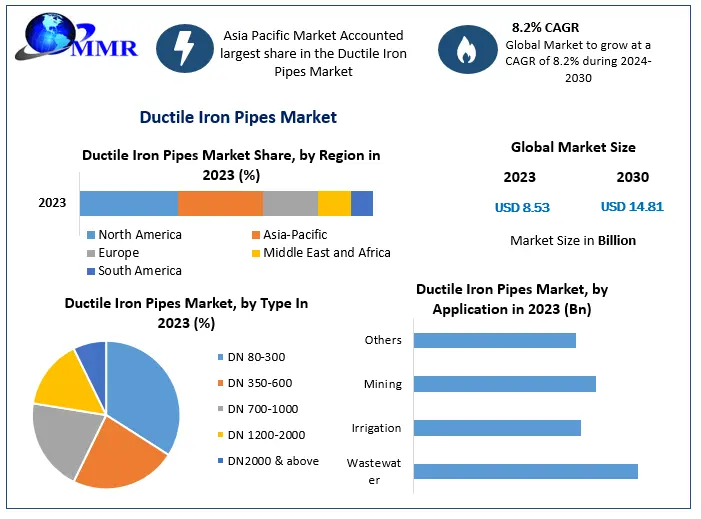
The global ductile iron pipes market size reached US$ 8.53 billion in 2023 and will scale to US$ 14.81 billion by 2030, driven by an annualized growth rate of 8.2%.
-
Drinking water distribution represents the dominant application segment, commanding over 50% of total industry value in 2023 and generating an absolute opportunity of US$ 3.46 billion through 2030.
-
Asia Pacific maintains the absolute largest regional footprint and is projected to expand at the highest global CAGR of 8.8% during the forecast period.
-
North America represents a highly dominant industrial sub-market, climbing at a steady 7.2% CAGR backed by resurgent construction activities post-2023 economic adjustments.
-
Volatility in global crude oil pricing and fluctuating raw material feedstock availability serve as the primary structural constraints to long-term manufacturing operations.
Why This Matters Now
Volatile macroeconomic dynamics are forcing municipal utility directors and industrial procurement officers to re-evaluate structural risk across water transmission investments. Traditional non-metallic alternatives are suffering critical thermal failures during intense seasonal swings. Industry leaders are abandoning sub-optimal materials in favor of heavy-metallurgy solutions that guarantee extreme temperature stability and structural resilience under high pressure.
What changed is the global threshold for infrastructure risk. Municipalities can no longer absorb the capital expenditure required to repair frequent pipeline fractures caused by volatile ambient conditions. Because ductile iron delivers unmatched fracture resistance and mechanical tensile strength across nominal diameters from 80mm to 2000mm and above, the material is transitioning from a premium specification to an absolute baseline requirement for major municipal and industrial distribution projects.
Market Overview
Industrialization initiatives and migratory population shifts across major economic corridors are reshaping global water utility architecture. The global Ductile Iron Pipes Market was valued at US$ 8.53 billion in 2023 and is positioned to reach US$ 14.81 billion by 2030, compounding at a clear 8.2% CAGR. This substantial surge reflects a deep, long-term capital commitment to structural resilience across public utility grids and private industrial installations alike.
The foundational driver behind this deployment is the physical limitation of alternative piping media. Ductile iron provides a high safety factor and an inherent ability to accommodate localized ground shifts without cracking, facilitating rapid installation in all weather conditions without specialized backfill materials. As governments deploy expansive capitalization campaigns for comprehensive wastewater management and municipal modernization, the underlying demand for reliable, large-bore piping solutions becomes a core driver of corporate backlogs for global metallurgical manufacturers.
Key Trends Driving Growth
Accelerating urbanization throughout developing geographies acts as the primary volume driver for heavy-duty distribution networks. As rural-to-urban population relocation stresses existing sanitary services, regional authorities must deploy heavy municipal water transmission lines capable of carrying vast volumes under high internal pressure. This demographic shift necessitates massive, multi-decade utility investments that directly consume high volumes of ductile iron pipe.
Concurrently, a decisive operational shift is occurring away from standard PVC substitutes. Polyvinyl chloride and other polymer-based alternatives are vulnerable to structural degradation under intense heat and mechanical brittleness during prolonged freeze cycles. In contrast, ductile iron maintains physical integrity across intense thermal variances, making it the preferred specification for hazardous processing environments, complex pharmaceutical production facilities, and heavy food and beverage manufacturing plants that require absolute operational security.
Segment Insights
-
Dominant Segment: Drinking Water Distribution — This segment held over 50% of the total market size in 2023. The dominance is sustained by widespread integration throughout commercial and residential construction sectors, requiring a massive absolute growth opportunity of US$ 3.46 billion over the forecast window due to its low failure rates.
-
Fastest-Growing Segment: Wastewater & Irrigation Systems — Driven by intense global regulatory pressures regarding environmental discharge and agricultural water conservation, this sub-segment is capturing rapid market share as municipal authorities mandate heavy-bore iron conduits to prevent industrial effluent leakage.
Regional Growth Story
The Asia Pacific region continues to dictate global volume dynamics, holding the largest market share in 2023 and pacing the world with the highest projected CAGR of 8.8% through 2030. Rapidly expanding industrial chemical hubs across China and India are demanding immense amounts of clean industrial process water while simultaneously upgrading complex wastewater discharge lines. This combined industrial and municipal consumption pattern ensures a sustained revenue pipeline for regional producers.
In North America, the market is developing along a steady 7.2% CAGR track, anchored firmly by a post-recession resurgence in commercial building permits and municipal grid updates. Industrial demand is heavily concentrated within advanced manufacturing sectors, including pharmaceutical complexes and chemical refinement operations across the United States. These high-value industries rely heavily on ductile iron networks to handle demanding process flows, insulating the regional market from broader consumer retail cyclicality.
Competitive Landscape
The competitive structure of the global ductile iron pipes market is highly concentrated, governed by legacy steel conglomerates and specialized metallurgical multinationals. Dominant global entities like Saint-Gobain, Kubota, US Pipe, Jindal SAW, and Xinxing Ductile Iron Pipes control the majority of manufacturing assets and raw material procurement networks. These firms leverage their massive operational scale to insulate themselves from volatile merchant pig iron prices and energy input costs.
Mid-tier manufacturers and regional suppliers, such as Electrotherm, Tata Metaliks, and Saudi Arabian AMIANTIT Company, focus heavily on capturing localized public works tenders. The high capital expenditure required to construct advanced blast furnaces and centrifugal casting lines creates a formidable barrier to entry, protecting the pricing power of established participants. As procurement specifications become stricter regarding pipeline longevity and pressure tolerances, market consolidation is accelerating, favoring firms with fully integrated upstream raw material supply chains.
Recent Developments
-
Industrial scale expansion across major manufacturing hubs has led to significant capital investments by market leaders like Xinxing Ductile Iron Pipes and Jindal SAW to optimize automated centrifugal casting lines.
-
Enhanced focus on internal liner technology, with producers introducing advanced polyurethane and epoxy coatings to maximize chemical resistance against acidic wastewater flows.
-
Strategic procurement adjustments by Western suppliers like US Pipe and McWane to secure long-term domestic scrap metal scrap streams, mitigating exposure to international trade tariffs.
Strategic Implications
The shifting landscape of the ductile iron pipes market signals a critical turning point for global steel and chemical industry supply chains. Volatility in global crude oil markets directly destabilizes the pricing of polymer-based substitutes, widening the economic competitive window for iron-based metallurgical products. Procurement leaders are locking in multi-year supply contracts for iron pipe to hedge against the pricing uncertainty of petrochemical alternatives.
For industrial project developers, the high safety factor and low mechanical failure rates of ductile iron pipe mean significantly lower insurance premiums and long-term maintenance liabilities. As commercial operations expand into areas with challenging soil geology or extreme weather conditions, the capacity to deploy resilient lines without complex, cost-heavy backfilling provides an immediate logistical edge. Companies that secure reliable, high-volume pipeline components early will successfully avoid project delays caused by regional infrastructure backlogs.
Future Outlook
Looking forward, the global market will increasingly reward fully integrated metallurgical manufacturers that control their feedstock supply lines from raw iron ore down to finished centrifugal castings. Companies relying heavily on fragmented merchant pig iron components face substantial margin compression as international trade volatility and energy pricing disruptions alter global foundry economics. Ultimately, the long-term strategic advantage belongs to manufacturers capable of delivering certified, high-pressure nominal diameter pipe lines that meet increasingly rigid international municipal engineering criteria.
Analyst Perspectiv
“The transition toward ductile iron is no longer just an engineering preference; it has become a core mandate for modern infrastructure resilience,” states Ankita Kagawade, Lead Analyst at Maximize Market Research. “As municipal entities confront the physical limits of alternative materials under severe environmental stresses, the proven tensile performance and structural longevity of ductile iron pipes ensure their position as the fundamental backbone of global water distribution systems through 2030.”
About Maximize Market Research
Maximize Market Research Pvt. Ltd. (MMR) is a global market research and consulting company that provides reliable, data-focused, and practical business insights. The firm serves a wide range of industries, including healthcare, pharmaceuticals, technology, automotive, electronics, chemicals, personal care, and consumer goods. Through market forecasts, competitive analysis, strategic consulting, and industry impact assessments, MMR helps organizations understand changing market conditions, identify growth opportunities, and make informed business decisions for long-term success.
2nd Floor, Navale IT Park Phase 3
Pune Banglore Highway, Narhe
Pune, Maharashtra 411041, India
+91 9607365656
[email protected]