
Key Highlights
-
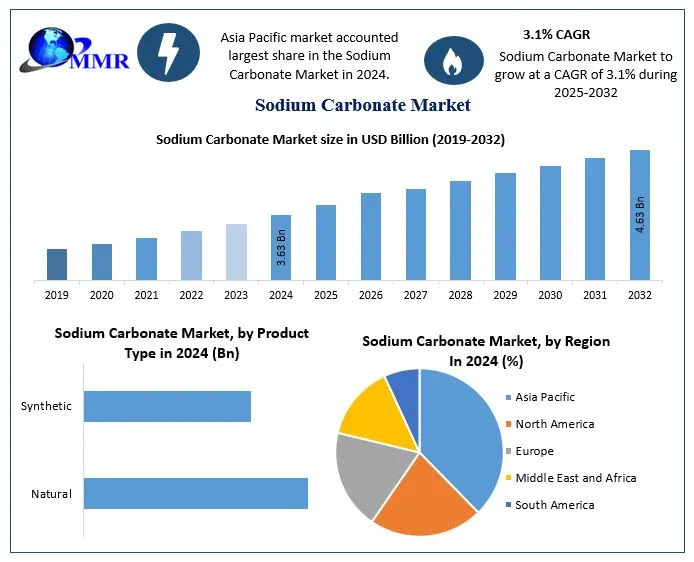
Market Expansion: Global valuation climbs from USD 3.63 Billion in 2024 to nearly USD 4.63 Billion by 2032, advancing at a 3.1% CAGR.
-
Dominant Region: The Asia-Pacific region maintains the largest market share, sustained by structural lower-cost manufacturing advantages.
-
Top Exporters: The United States leads global trade flows with USD 1.2 Billion in exports, followed by Turkey at USD 683 Million.
-
Fastest-Growing Segment: The chemical application sector leads downstream acceleration with an anticipated 3.4% CAGR during the forecast period.
-
Operational Restraints: Strict regulatory enforcement on particulate matter and greenhouse gas emissions limits processing margins.
Why This Matters Now
Volatile emission penalties and rapid cross-border manufacturing migrations are forcing industrial buyers to restructure their chemical supply chains immediately. Procuring stable volumes of sodium carbonate has transformed from a routine purchasing task into a complex risk-mitigation challenge for glass makers and chemical producers alike.
Rising regulatory pressures on calciner emissions mean that asset utilization rates are increasingly tied to environmental compliance. For institutional investors and commodity traders, understanding these shifting regulatory dynamics and regional production economics is critical to shielding industrial portfolios from sudden supply shortfalls.
Market Overview
The Sodium Carbonate Market , traditionally known as soda ash, acts as a critical chemical baseline for multiple heavy industries. The global market achieved a baseline valuation of USD 3.63 Billion in 2024. Driven by steady downstream integration, the market is on track to hit USD 4.63 Billion by 2032.
The baseline chemical properties of sodium carbonate dictate its deep market penetration. As a highly alkaline, water-soluble salt, it acts as an effective water softener by precipitating magnesium and calcium ions. In industrial manufacturing, it serves as an indispensable fluxing agent for silica, lowering the melting point of glass mixtures to optimize energy use.
Key Trends Driving Growth
Industrial production is shifting globally as Western chemical manufacturers relocate their manufacturing infrastructure to Asia. This movement is driven by access to government subsidies, cheaper labor, and distinct environmental regulatory structures. This geographic shift fundamentally changes global supply availability and long-haul trade routes.
Concurrently, new commercial avenues are expanding in the food processing industry. The Food and Drug Administration approves sodium carbonate as a safe texturizer, stabilizer, and neutralizing agent, opening higher-margin opportunities outside of traditional bulk commodity processing.
Segment Insights
-
Dominant Product Type: Synthetic Sodium Carbonate. The synthetic production path, relying primarily on the Solvay process, accounts for the largest share of global volume. It provides reliable regional supply close to major industrial consumers, though it faces higher energy costs.
-
Dominant End-Use Industry: Flat Glass & Container Glass. Glass production accounts for the highest total volume consumption. The material lowers the processing temperature of silica sand, directly determining energy costs for large glass melting furnaces.
-
Fastest-Growing Segment: Chemical Manufacturing. The chemical segment is projected to grow at a faster rate of 3.4% CAGR. This rapid growth stems from the material’s widespread use as an elite electrical conductor in electrochemistry, a reliable primary standard for acid-base titrations, and a safer alternative to chloride-based options that generate hazardous gases.
Regional Growth Story
The Asia-Pacific region holds the largest market share in the global landscape. This leadership is reinforced by ongoing production expansions in major industrial hubs like China and India, which absorb large volumes of both domestic and imported technical-grade soda ash.
Conversely, North America serves as a major export engine, driven by massive natural trona deposits in the United States. While the domestic US market benefits from steady building and infrastructure investments, its primary influence comes from massive export volumes shipped to global industrial markets.
Competitive Landscape
The market is characterized by consolidated supply control among a few dominant chemical conglomerates. Leaders like Tata Chemicals, Solvay, and FMC Corporation dictate market pricing power through large production footprints and well-established distribution channels.
Smaller regional producers, including Nirma Limited, OCI Chemical Corporation, Ciech, Soda Sanayii, and GHCL, compete by optimizing local logistics and targeting specific downstream niches. To secure their market share against rising energy costs, these top suppliers focus heavily on upgrading calciner efficiency and improving their logistics networks.
Recent Developments
-
Global Trade Compression: Total global sodium carbonate trade contracted from USD 3.8 Billion to USD 3.2 Billion, representing a 16.5% drop that reflects rising domestic consumption and changing tariff structures.
-
US Export Dominance: The United States solidified its position as the leading exporter, moving USD 1.2 Billion worth of material to outpace Turkey’s USD 683 Million in export value.
-
Import Barriers: High import tariffs in specific nations, such as the Bahamas at 40% and Bermuda at 24% continue to reshape traditional distribution routes and alter regional pricing margins.
Strategic Implications
The 16.5% drop in global trade volume signals that major production regions are prioritizing domestic supply security over open-market exports. This dynamic increases pricing power for localized producers and leaves import-dependent buyers exposed to localized supply disruptions.
Furthermore, strict air emission rules on processing plants mean suppliers must invest capital into updating older calciners and dryers. Companies that fail to modernize face forced capacity cuts, which will likely accelerate consolidation among the market’s top players.
Future Outlook
Long-term market success will belong to producers that successfully balance strict emissions compliance with cost-effective bulk logistics. The main risks lie in volatile energy prices and tightening environmental policies in developing countries, both of which could disrupt synthetic production margins. The most promising strategic opportunities will be found in expanding chemical and glass production lines across the Asia-Pacific region, where industrial demand continues to outpace localized supply capacity.
Analyst Perspective
“The structural relocation of manufacturing assets toward Asian industrial zones is fundamentally rewiring traditional supply lines. Procurement leaders can no longer count on steady, low-tariff export streams. To insulate operations from policy-driven capacity swings, buyers must prioritize supply contracts tied directly to natural, low-emission extraction sites.” — Ankita Kagawade, Lead Analyst, Maximize Market Research
About Maximize Market Research
Maximize Market Research Pvt. Ltd. (MMR) is a global market research and consulting company that provides reliable, data-focused, and practical business insights. The firm serves a wide range of industries, including healthcare, pharmaceuticals, technology, automotive, electronics, chemicals, personal care, and consumer goods. Through market forecasts, competitive analysis, strategic consulting, and industry impact assessments, MMR helps organizations understand changing market conditions, identify growth opportunities, and make informed business decisions for long-term success.
2nd Floor, Navale IT Park Phase 3
Pune Banglore Highway, Narhe
Pune, Maharashtra 411041, India
+91 9607365656
[email protected]