
Germany Carbon Neutral Market: Energy Transition, Green Innovation, and Industrial Decarbonization

The Germany Carbon Neutral Market is at the forefront of Europe’s sustainability transition, driven by ambitious climate policies, technological innovation, and strong industrial commitment to decarbonization. As Germany aims to achieve climate neutrality by 2045, the country is accelerating investments in renewable energy, energy efficiency, and carbon reduction technologies.
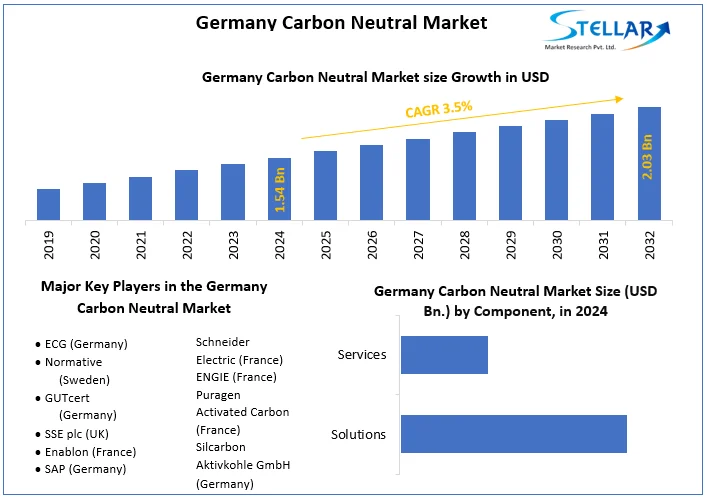
Germany Carbon Neutral Market size was valued at US$ 1.54 Bn. in 2024 and the total revenue is expected to grow at a CAGR of 3.5% through 2025 to 2032, reaching nearly US$ 2.03 Bn.
With its leadership in engineering and manufacturing, Germany is transforming its industrial ecosystem to align with global sustainability goals while maintaining economic competitiveness.
A Market Driven by Energiewende and Climate Policy
A defining trend in the Germany carbon neutral market is the implementation of the “Energiewende” (energy transition) strategy, which focuses on shifting from fossil fuels to renewable energy sources.
Government policies, carbon pricing mechanisms, and strict emissions regulations are encouraging industries to adopt low-carbon technologies. Corporate ESG initiatives are also playing a significant role, with companies committing to net-zero targets and investing in sustainable practices.
Key Market Insights
- Germany is a leader in carbon neutrality initiatives in Europe.
- Renewable energy, especially wind and solar, is expanding rapidly.
- Industrial decarbonization is a major focus area.
- Green hydrogen is a key emerging segment.
- Carbon capture technologies are gaining attention.
- Strong regulatory support is driving market growth.
- Investments in sustainable infrastructure are increasing.
𝐃𝐨𝐰𝐧𝐥𝐨𝐚𝐝 𝐅𝐫𝐞𝐞 𝐏𝐃𝐅 𝐁𝐫𝐨𝐜𝐡𝐮𝐫𝐞: https://www.stellarmr.com/report/req_sample/Germany-Carbon-Neutral-Market/241
Market Drivers Accelerating Growth
1. Ambitious Climate Targets
Germany’s goal of achieving climate neutrality by 2045 is a key driver.
2. Expansion of Renewable Energy
Wind and solar energy projects are accelerating decarbonization.
3. Industrial Transformation
Heavy industries are adopting low-carbon technologies to reduce emissions.
Market Challenges and Restraints
1. High Transition Costs
Shifting to renewable energy and low-carbon technologies requires significant investment.
2. Energy Supply and Infrastructure Challenges
Balancing energy demand with renewable supply can be complex.
Technology and Innovation Trends
Technological innovation is central to the Germany carbon neutral market. The adoption of renewable energy systems, carbon capture, utilization, and storage (CCUS), energy storage solutions, and green hydrogen technologies is accelerating the transition.
Germany is a global leader in wind energy, particularly offshore wind, and continues to expand solar power capacity. Hydrogen is emerging as a key solution for decarbonizing heavy industries such as steel, chemicals, and transportation.
Energy storage technologies and smart grids are enhancing the integration of renewable energy into the power system. Digital technologies, including AI and data analytics, are improving energy efficiency and enabling better resource management.
Electrification of transport and industrial processes is also contributing to emissions reduction.
𝐃𝐨𝐰𝐧𝐥𝐨𝐚𝐝 𝐅𝐫𝐞𝐞 𝐏𝐃𝐅 𝐁𝐫𝐨𝐜𝐡𝐮𝐫𝐞: https://www.stellarmr.com/report/req_sample/Germany-Carbon-Neutral-Market/241
Regional Insights: Industrial Hubs Lead Transformation
Germany’s industrial regions, including North Rhine-Westphalia, Bavaria, and Baden-Württemberg, are leading the carbon neutral transition.
Northern regions are focusing on offshore wind energy, while southern regions are investing in solar power and industrial efficiency.
Urban centers are adopting sustainable infrastructure and smart city initiatives to reduce emissions and improve energy efficiency.
Recent Industry Developments
- Siemens Energy (2025): Expanded hydrogen and renewable energy solutions.
- RWE (2024): Increased investments in offshore wind projects.
- BASF (2025): Focused on reducing industrial emissions and sustainable production.
- Federal Ministry for Economic Affairs and Climate Action (2024): Promoted policies for energy transition and decarbonization.
- European Commission (2025): Supported climate neutrality initiatives across Europe.
Competitive Landscape
The Germany carbon neutral market is highly competitive, with energy companies, industrial players, and technology providers actively investing in sustainable solutions. Companies are focusing on renewable energy development, carbon management technologies, and strategic partnerships to strengthen their market position.
Collaborations between industry and government are key to accelerating innovation and achieving climate goals.
Analyst Perspective
A senior market analyst notes:
“Germany’s carbon neutral market is a global benchmark for sustainable industrial transformation. Continued investment in innovation and infrastructure will be critical for long-term success.”
Future Outlook
The Germany Carbon Neutral Market is expected to witness strong growth in the coming years, supported by ambitious climate targets, advancements in clean technologies, and increasing investments in renewable energy.
The expansion of hydrogen infrastructure, development of carbon capture solutions, and integration of smart energy systems will continue to shape the market.
As Germany progresses toward its climate neutrality goals, the market will offer significant opportunities for investors, technology providers, and industrial players.
Overall, the market is set to play a pivotal role in shaping a sustainable and low-carbon future for Europe and beyond.

-Industry.PNG "Brazil Banking-as-a-Service (BaaS) Market: Fintech Innovation, Open Banking, and Financial")