
Key Highlights
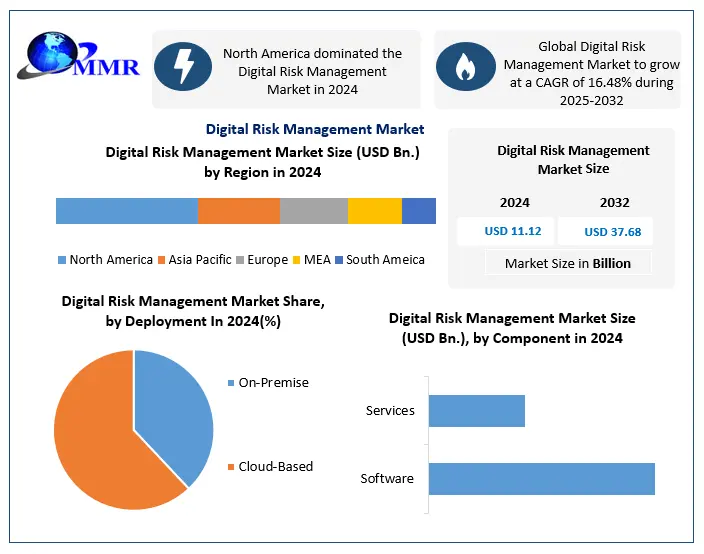
- Cyber risk has moved from an IT control issue to a business survival issue as enterprises digitize operations, expose more data and depend on cloud, mobile apps and e-commerce channels. The Digital Risk Management Market was valued at USD 11.12 Bn in 2024 and is expected to reach nearly USD 37.68 Bn by 2032, creating a major opportunity for cybersecurity platforms, cloud compliance vendors, AI risk systems and enterprise software providers.
- The Digital risk management market is forecast to grow at a 16.48% CAGR from 2025 to 2032, showing that digital risk management is becoming a strategic layer for enterprise resilience and technology governance.
- Cloud deployment dominated in 2024 because enterprises are adopting cloud-based systems and need risk controls across hybrid, multi-cloud and public cloud environments.
- Large enterprises dominated in 2024 because they have larger digital operations, higher financial capacity and stronger need to prevent emerging threats linked to digital transformation.
- North America held more than 43% share, while Asia Pacific is the fastest-growing region because cloud platforms, e-commerce and digital security demand are expanding in India and China.
Why This Matters Now
Digital transformation has widened the enterprise attack surface. Mobile apps, cloud services, IoT, AI, social media and e-commerce channels create new points of exposure, forcing companies to predict threats before they disrupt operations.
Digital risk management gives boards, CIOs and CISOs a framework to identify vulnerabilities and apply mitigation measures before or while new technologies are introduced. The objective is not only cyber defense; it is to stop digital risk from obstructing enterprise growth and management.
Market Overview
Digital risk management is the process of building a framework to predict threats and vulnerabilities linked to digital risk. It allows organizations to identify potential risks, proactively reduce them and create a disciplined approach for managing cybercrime, data leaks and technology-driven exposure.
The Digital risk management market is segmented by deployment into on-premise and cloud-based models. It is segmented by enterprise size into large enterprises and SMEs, by component into software, services, consulting, integration and implementation, and support and maintenance, and by end user into BFSI, IT and Telecom, Healthcare, Government and Public Sector, Retail and E-commerce, Manufacturing, Energy and Utilities, and others.
The public page contains a visible header inconsistency: the top panel lists USD 11.12 Bn as forecast market size, while the overview and scope table state USD 11.12 Bn in 2024 and USD 37.68 Bn by 2032. This article uses the overview and scope-table figures because they match the supplied market-size statement.
Key Trends Driving Growth
Rapid digitalization is the first growth driver. MMR states that businesses are adopting digital technologies after the pandemic, while mobile app usage, consumer demand and digital business models are pushing enterprises to modernize risk management.
Cloud adoption is the second driver. Digital risk protection is rising because organizations are adopting cloud-based solutions, and IBM is cited for cloud-based risk management offerings across hybrid, multi-cloud and public cloud environments with security and compliance controls.
AI and machine learning are becoming major opportunity layers. Financial technology companies such as MasterCard and Visa are developing AI and ML technologies to predict and prevent financial fraud in e-commerce transactions, making fraud detection faster and more automated.
E-commerce is intensifying cyber risk. Online shopping platforms hold names, addresses, bank details and phone numbers, making them targets for attackers and raising demand for e-security and digital risk management.
The main restraints are awareness and cost. Many organizations remain unaware of digital risk management benefits, while SMEs can face budget constraints because effective digital risk management requires significant investment.
Start Your Market Research Journey with a Free Sample Report
Segment Insights
- Dominant Segment Cloud Deployment: The cloud segment dominated in 2024. Cloud computing offers cost-effectiveness, agility, security, scalability and elasticity, while cloud services such as IaaS, PaaS, serverless computing and SaaS support digital transformation.
- Dominant Enterprise Size Large Enterprises: Large enterprises dominated in 2024 because they are adopting digital processes supported by big data, 5G networking, IoT and social media to increase efficiency, reduce costs and gain competitive advantage.
- Fastest-Growing Segment SMEs: SMEs are expected to record the highest growth during the forecast period because they are focusing on advanced cloud-based risk compliance policies and cost-effective services.
- Component Scope Software and Services: The market covers software, services, consulting, integration and implementation, and support and maintenance, but the public page does not disclose component-level market shares or CAGRs.
- End-User Scope BFSI, IT and Telecom, Healthcare, Government, Retail and E-commerce: These end users are covered, but the public page does not rank them by revenue share or growth rate.
Regional Growth Story
North America dominated the Digital Risk Management Market and held more than 43% share. The United States is expected to hold the maximum share of the regional market, supported by the strong presence of key players and rapid adoption of technologies such as big data, AI and machine learning.
The regional business implication is clear: North American enterprises are treating data security and digital risk as core requirements as digitalization increases. The region’s technology base gives vendors a faster route to enterprise adoption and platform consolidation.
Asia Pacific is the fastest-growing market. Rising use of cloud service platforms such as IaaS, PaaS and SaaS, along with emerging e-commerce industries in India and China, is boosting demand for digital security and risk management.
The report covers the United States, Canada, Mexico, the UK, France, Germany, Italy, Spain, Sweden, Austria, China, South Korea, Japan, India, Australia, Indonesia, Malaysia, Vietnam, Taiwan, Bangladesh and Pakistan. The public page does not disclose country-level revenue, data center investments, telecom infrastructure expansion, edge computing adoption or detailed 5G deployment metrics.
Competitive Landscape
Key players include Microsoft, IBM Corporation, Oracle, SAS Institute, SAP, Broadcom, NAVEX Global, Logic Manager, MetricStream, Rapid7, Qualys, RSA Security, ServiceNow and OTORIO. The field combines cloud providers, cybersecurity vendors, GRC platforms, enterprise software companies and operational risk specialists.
Microsoft offers Microsoft Purview Insider Risk Management, which detects, identifies and acts on potential organizational risks. That signals a shift toward embedded risk controls inside enterprise productivity and data governance ecosystems rather than separate compliance tools.
IBM offers artificial intelligence, cloud computing, hybrid cloud and security services for digital risk management. Its positioning shows that enterprise buyers want risk platforms that can operate across cloud, compliance and third-party ecosystems, not only point cybersecurity tools.
Oracle, SAS Institute, SAP, Broadcom and NAVEX Global focus on digital risk management services for organizations, while key players are pursuing expansion through mergers, acquisitions and strategic partnerships. This signals a market moving toward broader enterprise risk platforms and integrated compliance services.
Recent Developments
- Cloud-Based Risk Controls: IBM is cited for hybrid, multi-cloud and public-cloud risk management solutions that deploy customized security and compliance controls across enterprise and third-party ecosystems.
- AI Fraud Detection: MasterCard and Visa are cited as financial technology companies developing AI and ML technologies to predict and prevent transaction fraud across e-commerce platforms.
- Government Cybersecurity Investment: Governments worldwide are making significant investments to improve cybersecurity, supporting demand for digital risk management.
Strategic Implications
For CIOs and CISOs, digital risk management is becoming part of enterprise architecture. The strongest business case connects cloud security, fraud detection, compliance controls, data protection, third-party risk and proactive threat intelligence.
For cloud providers and enterprise software vendors, risk management is now a platform opportunity. Cloud environments are becoming standard for digital transformation, but buyers need security, compliance and risk controls that work across more than one cloud environment.
For investors, the market offers exposure to cybersecurity, cloud compliance, AI threat intelligence, fraud detection, GRC software, e-commerce security and SME risk automation. The main risks are weak awareness, high implementation cost, budget limits and incomplete public disclosure on segment-level revenue shares.
Future Outlook
The Digital Risk Management Market is forecast to grow from USD 11.12 Bn in 2024 to nearly USD 37.68 Bn by 2032 at a 16.48% CAGR. Growth will come from cloud deployment, large-enterprise investment, SME adoption, AI and ML fraud detection, e-commerce risk, government cybersecurity investment, digital transformation and rising cybercrime threats.
The next phase will test whether enterprises can convert risk management from reactive compliance into automated digital resilience. Future digital leaders will control AI-enabled, cloud-integrated risk systems across every digital channel; laggards will remain exposed to fragmented controls while cyber threats move faster than their response models.
Analyst Perspective
“Digital risk management is becoming strategic enterprise infrastructure as cloud adoption, e-commerce growth, AI-enabled fraud detection and cyber threats reshape technology governance,” said Yash Ghosalkar, Analyst at Maximize Market Research. “The strongest providers will combine cloud compliance, threat intelligence, AI automation, third-party ecosystem controls and scalable risk services for large enterprises and SMEs.”
About Maximize Market Research
Maximize Market Research Pvt. Ltd. (MMR) is a global market research and consulting company that provides reliable, data-focused, and practical business insights. The firm serves a wide range of industries, including healthcare, pharmaceuticals, technology, automotive, electronics, chemicals, personal care, and consumer goods. Through market forecasts, competitive analysis, strategic consulting, and industry impact assessments, MMR helps organizations understand changing market conditions, identify growth opportunities, and make informed business decisions for long-term success.
Contact Us
2nd Floor, Navale IT Park Phase 3
Pune Banglore Highway, Narhe
Pune, Maharashtra 411041, India
+91 9607365656
[email protected]