
Key Highlights
-
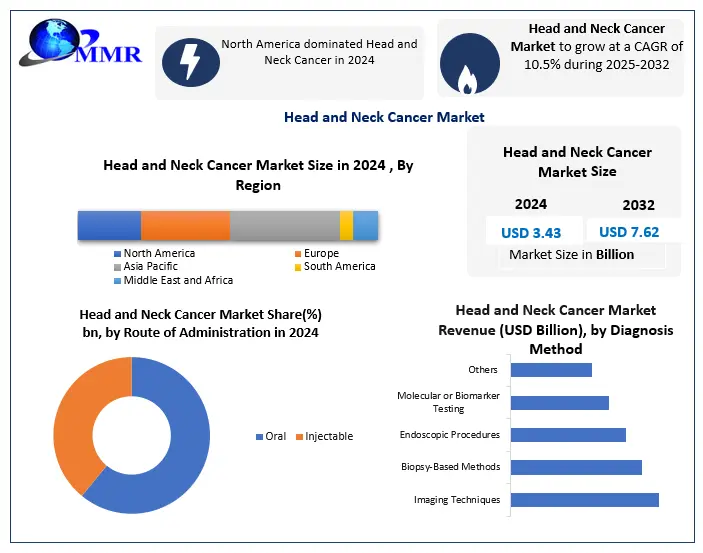
Market Valuation: The global head and neck cancer market size reached USD 3.43 billion in 2024 and is projected to expand to USD 7.62 billion by 2032.
-
Growth Velocity: The market is compounding at a steady Compound Annual Growth Rate (CAGR) of 10.5% from 2025 to 2032.
-
Dominant Segment: Epidermal Growth Factor Receptor (EGFR) inhibitors held the leading market share by drug class in 2024, led by widespread clinical adoption of therapies like cetuximab.
-
Fastest-Growing Segment: Immunotherapy is projected to dominate the market over the forecast period, driven by the rapid uptake of checkpoint inhibitors like pembrolizumab and nivolumab.
-
Geographic Leadership: North America maintains dominance in the global marketplace, supported by high diagnostic volume, strong commercial insurance reimbursement, and robust corporate R&D spending.
Why This Matters Now
Clinical oncology is witnessing an aggressive structural shift in how malignancies of the oral cavity, pharynx, and larynx are diagnosed and treated. For healthcare providers, pharmaceutical developers, and institutional investors, the status quo of relying solely on broad-spectrum chemotherapy is rapidly dissolving. Escalating disease prevalence—compounded by human papillomavirus (HPV) infections, tobacco usage, and an aging global population—demands a rapid pivot toward localized, biomarker-driven clinical strategies.
The business of oncology now favors developers capable of moving early-stage assets through regulatory pipelines to capture premium pricing. Conversely, delayed adoption of precision medicine frameworks risks squeezing provider margins under value-based care reimbursement systems.
Market Overview
The Head and neck cancer market is expanding rapidly, transitioning from legacy cytotoxic treatments to an era of specialized targeted therapies and immuno-oncology. The global market size stood at USD 3.43 billion in 2024, with expectations to climb to USD 7.62 billion by 2032, advancing at a 10.5% CAGR. This upward trajectory is catalyzed by an annual diagnostic burden of thousands of new cases globally, creating commercial demand across the care continuum.
This commercial growth faces barriers from high out-of-pocket costs and uneven clinical infrastructure in emerging economies. The multidisciplinary care required for head and neck cancers—combining surgery, radiation, and complex systemic therapies—imposes heavy financial pressure on healthcare payers. Advanced targeted therapeutics and immunotherapies command premium pricing, which limits patient access in low- and middle-income regions. These regional capital gaps and long specialist waiting lists restrict advanced therapy adoption, creating a bifurcated market between premium and cost-constrained geographies.
Key Trends Driving Growth
The convergence of precision diagnostics, cellular therapies, and digital monitoring tools is fundamentally altering the market’s commercial landscape.
Precision Medicine and Biomarker Testing
Oncologists are moving away from empirical matching toward prospective biomarker testing. Evaluating PD-L1 expression levels and EGFR genetic overexpression before selecting a treatment plan improves objective response rates and reduces toxicities. This molecular segmentation helps identify the patient subgroups most likely to respond favorably, streamlining clinical positioning and supporting favorable reimbursement decisions from commercial payers.
Advanced Diagnostics and Liquid Biopsy
Early stage screening is shifting from invasive tissue extractions toward next-generation imaging and liquid biopsies. These non-invasive blood tests detect circulating tumor DNA (ctDNA) shedding from head and neck tumors before structural changes appear on standard scans. Early detection changes the commercial landscape by shifting therapeutic volume from late-stage palliative management to early-stage, high-margin curative interventions.
Digital Health Platforms and Tele-Oncology
Hospital networks are deploying specialized digital health platforms to manage the complex toxicities associated with head and neck cancer regimens. Tele-oncology pathways facilitate remote symptom monitoring, nutritional tracking, and swallow-function rehabilitation. These digital integrations improve patient adherence to prolonged therapeutic protocols, reducing hospital readmissions and aligning with value-based healthcare performance metrics.
Segment Insights
-
EGFR Inhibitors (Dominant Segment): Epidermal Growth Factor Receptor (EGFR) inhibitors led the drug class segment in 2024. Because EGFR is overexpressed in a high percentage of head and neck tumors, monoclonal antibodies like cetuximab remain a standard baseline care option. Widespread regulatory approvals in North America and Europe, combined with established clinical protocols alongside radiotherapy, support this segment’s leading market share.
-
Immunotherapy (Fastest-Growing Segment): Immunotherapy is projected to dominate the market over the forecast period. Immune checkpoint inhibitors, specifically pembrolizumab and nivolumab, have reshaped frontline care for recurrent or metastatic squamous cell carcinomas. Endorsements from major clinical societies like the NCCN and ASCO are driving high adoption rates, while ongoing trials explore combination regimens to overcome tumor resistance.
Regional Growth Story
North America continues to lead the global market, driven by high diagnostic volume and infrastructure advantages. The National Cancer Institute estimates that approximately 72,680 individuals in the United States will be diagnosed with oral cavity, pharynx, or larynx cancers in 2025, resulting in roughly 16,680 deaths. This substantial disease burden is met by rapid clinical adoption of advanced therapeutics, including checkpoint inhibitors and targeted small molecules. Market momentum in the region is further sustained by corporate R&D investment and supportive commercial reimbursement systems.
Emerging markets across Asia-Pacific and parts of Europe are expanding their clinical footprints through public-health screening initiatives. Government awareness programs addressing tobacco use and rising HPV-related cancer rates are expanding the addressable patient population in countries like India and China. However, real-world commercial growth in these regions depends heavily on expanding local healthcare infrastructure and closing the insurance coverage gaps that limit access to premium-priced biologics.
Competitive Landscape
The competitive matrix is defined by intense capital deployment among top-tier biopharmaceutical companies aiming to protect and expand their oncology portfolios. Heavy hitters like Merck & Co., Bristol-Myers Squibb, Eli Lilly, AstraZeneca, F. Hoffmann-La Roche, Sanofi, and Takeda are competing to advance combination regimens that pair established checkpoint inhibitors with novel small molecules.
To hedge against patent expirations and pipeline gaps, these industry leaders are pursuing targeted acquisitions and cross-industry licensing deals. These transactions focus heavily on acquiring platforms that target treatment-resistant tumor mutations, shifting the market toward personalized therapy.
Recent Developments
-
Strategic Research Alliances: Mid-stage biotechs are partnering with major research institutions to advance early-stage pipelines. For example, Aprea Therapeutics established a clinical collaboration with the MD Anderson Cancer Center to evaluate novel drug candidates for targeted patient populations.
-
Targeted Program Acquisitions: Leading drugmakers are actively purchasing specialized oncology assets to strengthen their pipelines. Eli Lilly acquired Scorpion Therapeutics’ PI3Kα-targeted program, directly expanding its therapeutic footprint in head and neck oncology.
-
Combination Trial Expansions: Corporate sponsors are expanding clinical evaluation programs for dual-mechanism therapies. Ongoing phase II and III trials are examining the efficacy of combining PD-1/PD-L1 inhibitors with next-generation EGFR agents to delay systemic treatment resistance.
Strategic Implications
For pharmaceutical executives, the commercial lesson is clear: standalone therapies face declining market share as the industry moves toward multi-agent combination regimens. Success requires a proactive approach to pairing immunotherapies with targeted small molecules or radiation protocols.
Hospital networks must also invest in the diagnostic infrastructure required for molecular testing and liquid biopsies. Failing to provide these precision diagnostics risks losing patient volume to larger, integrated regional oncology networks.
Future Outlook
The global head and neck cancer market will continue to expand as biomarker validation and next-generation diagnostic tools become standard components of clinical care. Over the next decade, commercial success will depend on a company’s ability to demonstrate value-based outcomes to payers while maintaining steady clinical trial pipelines.
Future market leaders will be distinguished by their ability to seamlessly integrate companion diagnostics with multi-mechanism combination therapies, while laggards remain tethered to declining, non-stratified blockbuster drug models.
Analyst Perspective
“The commercial paradigm in head and neck oncology has permanently moved beyond generic cytotoxic interventions. Future market value belongs to biopharmaceutical innovators who can successfully commercialize biomarker-driven combination therapies that extend progression-free survival while minimizing systemic toxicities for an aging global population.” — Komal Patil, Healthcare & Life Sciences Research Analyst at Maximize Market Research
About Maximize Market Research
Maximize Market Research Pvt. Ltd. (MMR) is a global market research and consulting firm known for delivering accurate, actionable, and data-driven insights. Our expertise spans diverse industries — including medical devices, pharmaceuticals, technology, automotive, electronics, chemicals, personal care, and consumer goods. We provide services such as market-validated forecasts, competitive intelligence, strategic consulting, and industry impact analysis, helping businesses navigate market complexities and achieve sustainable growth.
2nd Floor, Navale IT Park Phase 3
Pune Banglore Highway, Narhe
Pune, Maharashtra 411041, India
+91 9607365656
[email protected]