

Key Highlights
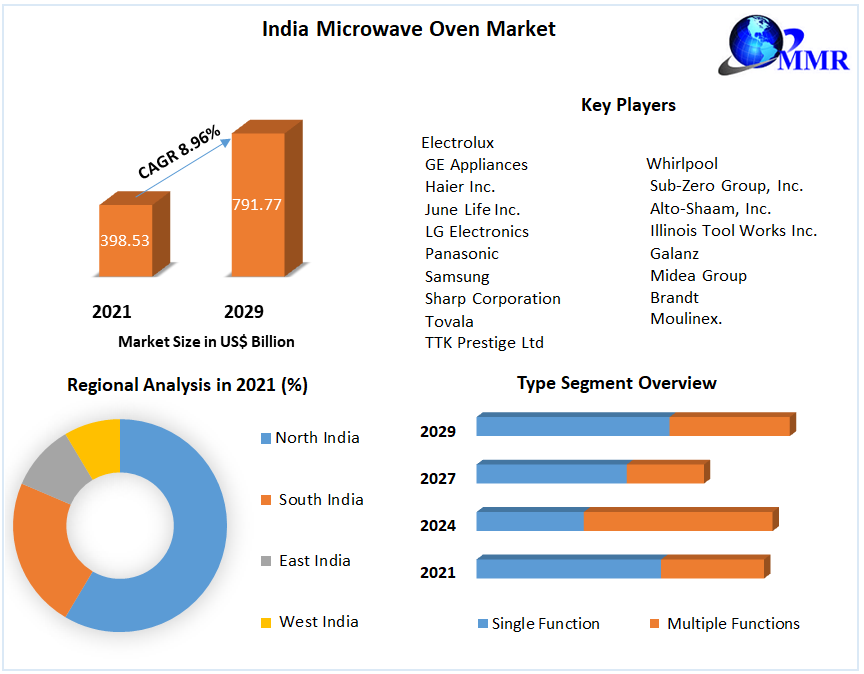
- India Microwave Oven Market was valued at US$ 398.53 Bn in 2021 and is expected to reach nearly US$ 791.77 Bn by 2029, creating a larger appliance-electronics opportunity across urban kitchens and commercial use.
- The market is expected to grow at an 8.96% CAGR from 2022 to 2029, making microwave ovens a recovery-and-repositioning story rather than a simple penetration story.
- Convection microwave ovens account for 70% of sales, making them the dominant disclosed segment and the premium benchmark for brands.
- Solo ovens account for 10% of sales and are expected to grow at 15% per annum, making them the fastest-growing disclosed category.
- Microwave oven penetration in India is only 4% of the population, leaving long-term headroom if brands can make the appliance feel essential rather than optional.
Why This Matters Now
India’s microwave oven market is no longer selling technology alone; it is selling relevance. Young professionals, students and migrant households are buying basic models, while many traditional buyers still view the appliance as useful mainly for reheating.
That split creates a strategic test for electronics OEMs. The market can nearly double by 2029, but brands must decide whether to defend high-end convection features or use affordable solo ovens to expand penetration.
Market Overview
The India Microwave Oven Market covers single-function and multiple-function ovens by type, built-in and countertop structures, and residential and commercial applications. The public page gives a base-year value of US$ 398.53 Bn in 2021 and a forecast value of US$ 791.77 Bn in 2029.
For electronics and semiconductor suppliers, the market is tied to appliance control systems, heating electronics, sensors, timers, display panels and smart interfaces. The public page does not disclose AI chip demand, semiconductor manufacturing capacity, foundry investments, advanced packaging, HBM, chiplet architecture or memory and logic chip trends.
The market’s core issue is consumer behavior. MMR states that Indian customers are no longer strongly attracted by microwave cooking and increasingly buy basic models online instead of high-end convection models in stores.
Key Trends Driving Growth
Affordability is changing the product mix. Consumers are moving from convection models priced above 10,000 toward solo models priced in the 5,000–7,000 range, which shifts growth from premium functionality to entry-level access.
The appliance has also moved into gifting and utility use. MMR states that many consumers use microwaves mainly for reheating and do not consider them a need like refrigerators or air conditioners, which explains why brands must rebuild category value.
Smart cooking is still a competitive lever. Samsung launched the My Recipe App for Android users, with more than 300 auto-cook recipes and more than 50 conventional recipes customized for Samsung Smart Ovens, signaling that software can help overcome low cooking engagement.
Tier II and III cities are becoming more important. Samsung reported traction beyond established metro markets, while Panasonic entered the solo microwave range for young single professionals and students whose cooking needs are limited.
Smart-device adoption is disclosed through Samsung’s Android app, but IoT penetration is not quantified. Sustainability initiatives, e-waste management, government incentives, display technology developments and supply-chain dynamics are not disclosed on the public page.
Get Your Exclusive Market Research Sample Report Today
Segment Insights
- Dominant Segment Convection Microwave Ovens: Convection microwave ovens account for 70% of sales, mostly in urban zones. This gives premium-feature models the largest disclosed revenue base, even as growth pressure shifts toward basic formats.
- Fastest-Growing Segment Solo Microwave Ovens: Solo ovens account for 10% of sales and are expected to grow at 15% per annum. Their growth is tied to young buyers, first-time buyers and smaller cities.
- Secondary Segment Grill Ovens: Grill ovens account for 20% of sales. The public page does not disclose a growth rate for this segment.
- Demand Base Young and First-Time Buyers: Around 70% of solo ovens are accepted by young and first-time purchasers in smaller cities, making entry-level ovens a route to category expansion.
- Structure and Application Scope: Built-in and countertop structures are covered, as are residential and commercial applications. Segment-level values are not disclosed.
Regional Growth Story
This is an India-specific report, with regional coverage split into North India, South India, East India and West India. The public page does not disclose regional shares, city-level values or state-level growth rates.
The strongest geographic signal is urban and semi-urban expansion. Convection models are concentrated mostly in urban zones, while solo ovens are gaining acceptance among younger and first-time buyers in smaller cities.
Tier II and III demand matters because it can widen penetration beyond metro households. Samsung’s push into these locations and Panasonic’s solo microwave entry show that brands are trying to convert mobility, smaller households and limited cooking needs into appliance demand.
The report does not provide comparative data for the United States, Taiwan, South Korea, China, Japan or Germany. It also does not disclose semiconductor sovereignty programs, fabrication incentives or export dynamics, so regional analysis must remain focused on India’s consumer-appliance structure.
Competitive Landscape
Key players include Electrolux, GE Appliances, Haier, June Life, LG Electronics, Panasonic, Samsung, Sharp, Tovala, TTK Prestige, Whirlpool, Sub-Zero Group, Alto-Shaam, Illinois Tool Works, Galanz, Midea Group, Brandt and Moulinex. Indian and global appliance brands compete in a category where penetration is still low but consumer conviction remains uneven.
LG helped build the category by teaching consumers how to use microwaves for Indian cuisine, but MMR states that Korean players later stopped pushing the category. That signals a marketing gap: microwave adoption in India depends on cooking education as much as hardware availability.
Samsung’s market-share movement is a major competitive signal. The company had 33% share by volume and 35.5% by value in 2017, up from 22% by volume and 23.5% by value in 2013, and targeted a stronger position through India-specific innovation and dealer reach.
Samsung’s range was available through around 29,000 dealers, giving it a distribution advantage in a market where appliance confidence depends on physical access and brand visibility. The company imported its complete microwave range from international factories, showing that domestic demand was supported by global appliance supply rather than disclosed local microwave manufacturing.
Named M&A, partnerships, fab investments, packaging breakthroughs and chip-capacity expansions are not disclosed. Over the next 12–24 months, competition will likely center on entry-level solo pricing, recipe-led software, tier II and III distribution, and whether premium convection models can regain cooking relevance.
Recent Developments
- Samsung Smart Oven App: Samsung launched the My Recipe App for Android users, offering more than 300 auto-cook recipes and more than 50 conventional recipes customized for 20 Samsung Smart Ovens.
- Panasonic Solo Microwave Entry: Panasonic entered the solo microwave range for young single professionals and students with limited cooking needs, signaling sharper focus on entry-level demand.
- Channel Shift: Customers are choosing basic models online over high-end convection models from stores, forcing brands to rethink pricing, retail strategy and product positioning.
- Demonetization Impact: The category declined by 6.9% by volume in 2017 over 2015, showing that discretionary appliance demand can weaken sharply during liquidity shocks.
Strategic Implications
For semiconductor and component suppliers, microwave ovens offer appliance-electronics demand through control boards, sensors, displays and smart interfaces. The public page does not disclose chip suppliers, semiconductor content, foundry sourcing, advanced packaging or memory and logic trends.
For appliance OEMs, the largest commercial question is product-market fit. Convection ovens dominate sales, but solo ovens are growing faster because they match the use case of reheating, basic cooking and affordable ownership.
For retailers, online buying is changing price discovery. If customers prefer basic online models, store-led premium selling must offer stronger demonstrations, financing, bundled service or recipe education to justify higher prices.
Future Outlook
India Microwave Oven Market is expected to grow from US$ 398.53 Bn in 2021 to nearly US$ 791.77 Bn by 2029 at an 8.96% CAGR. The public page also shows a FAQ figure of 14.65% CAGR, creating an inconsistency; this article uses the overview and scope figure of 8.96% because it matches the supplied market-size statement.
Growth will depend on solo ovens, younger households, tier II and III cities, smart recipe interfaces, dealer reach and online access. The category’s risk is equally clear: low penetration will not convert into mass adoption unless brands make microwaves necessary for Indian kitchens.
Future technology leaders will combine affordable hardware, smart cooking software and city-tier distribution; laggards will remain trapped selling high-end features to consumers who only want reheating.
Analyst Perspective
“India’s microwave oven market is shifting from premium appliance selling to use-case-led electronics adoption,” said Rucha Deshpande, Analyst at Maximize Market Research. “The strongest players will combine solo oven affordability, smart recipe software, dealer reach and consumer education that makes microwaves relevant to everyday Indian cooking.”
About Maximize Market Research
Maximize Market Research Pvt. Ltd. (MMR) is a global market research and consulting company that provides reliable, data-focused, and practical business insights. The firm serves a wide range of industries, including healthcare, pharmaceuticals, technology, automotive, electronics, chemicals, personal care, and consumer goods. Through market forecasts, competitive analysis, strategic consulting, and industry impact assessments, MMR helps organizations understand changing market conditions, identify growth opportunities, and make informed business decisions for long-term success.
Contact Us
2nd Floor, Navale IT Park Phase 3
Pune Banglore Highway, Narhe
Pune, Maharashtra 411041, India
+91 9607365656
[email protected]


