
Key Highlights
-
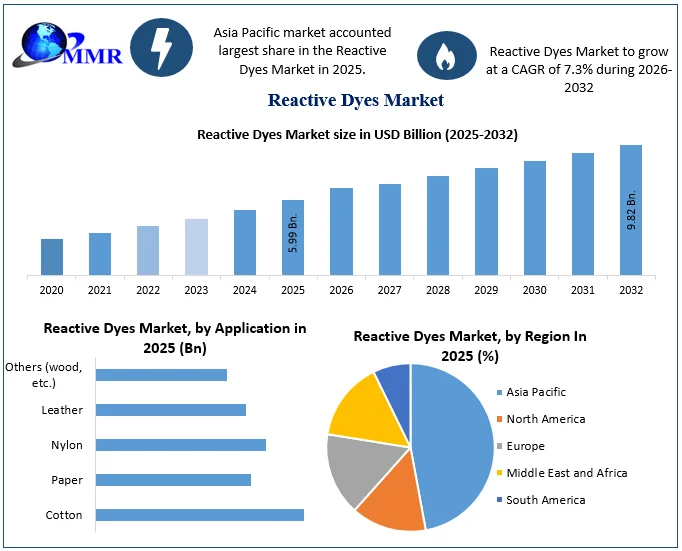
Market Valuation: Reaches USD 9.82 billion by 2032 from USD 5.99 billion in 2025, expanding at a 7.3 percent compound annual growth rate.
-
Consolidation Shift: Zhejiang Longsheng Group fully acquired DyStar Group for over USD 688 million, ending governance disputes to capture premium processing capacity.
-
Downstream Dependency: Market survival hinges entirely on natural and synthetic fiber demand across clothing, homewares, paper, and leather applications.
-
Regional Dominance: Asia-Pacific controls the largest market share, leveraging low labor costs, accessible land, and dense manufacturing infrastructure in China and India.
-
Green Innovation: Strategic collaborations bundle low-temperature bleaching with advanced dyes to slash processing emissions and water consumption by 50 percent.
Why This Matters Now
Tightening environmental compliance frameworks across developing and developed economies are squeezing standard synthetic dye manufacturers out of traditional supply chains. Industrial buyers must adapt immediately to an era where resource consumption defines procurement costs. Corporate consolidation, such as major share buybacks and business acquisitions, signals that market power is clustering into fewer hands. Companies failing to transition to low-temperature, resource-saving coloration systems face margin depletion and sudden vendor disqualification.
Market Overview
The Reactive Dyes Market function as colored organic compounds that establish permanent covalent bonds with specific substrate components, particularly cotton fibers. This chemical bonding distinguishes them from temporary surface colorants, making them indispensable for high-durability textiles, paper, wood, nylon, and leather processing. Fluctuations within downstream textile, apparel, and consumer product manufacturing dictate the volume requirements and overall price stability of the global supply chain.
The industry entered a critical transformation phase in 2025 with an established global valuation of USD 5.99 billion. Driven by population expansion and shifting global lifestyle preferences, industrial demand is projected to climb steadily to USD 9.82 billion by 2032. This trajectory reflects a 7.3 percent compound annual growth rate during the forecast period. It forces manufacturers to optimize production capacities while managing regulatory constraints on synthetic chemical effluents.
Key Trends Driving Growth
Surging consumption across downstream applications—namely paper, leather, and high-volume textiles—acts as the primary catalyst for product demand. Rising disposable incomes and fast-changing fashion lifecycles among young consumer segments push textile mills to increase throughput, directly increasing chemical consumption. This rapid operational scaling attracts new financial backing to expand local paper and garment processing infrastructure.
Concurrently, strict regulatory oversight concerning industrial wastewater discharges presents a significant structural challenge. Developed and emerging nations are enforcing limits on hazardous byproducts, creating a stark performance gap between legacy commodity dyes and premium eco-friendly variants. To maintain access to strict international supply chains, manufacturers are upgrading to specialized molecular formulations that minimize chemical rinse cycles.
Segment Insights
-
Cotton Application (Dominant Segment): Cotton processing commands the highest share of the global reactive dyes market due to its widespread application in clothing, industrial fabrics, and home homewares. The segment’s expansion dictates bulk production schedules for major dye houses worldwide.
-
Digital Printing Inks & Specialty Fibers (Fastest-Growing Segment): Advanced reactive inks engineered for high-performance digital printing on natural fibers represent the fastest-accelerating product group. Driven by the need for processing sustainability and extreme coloristic performance, this segment captures premium margins over standard formulations.
Regional Growth Story
The Asia-Pacific region maintains absolute dominance in the global reactive dyes market and is poised to sustain the highest growth rate through 2032. China and India serve as the core anchors of this geographic footprint, driven by massive domestic populations and extensive manufacturing footprints. The region benefits from lower labor costs, highly accessible raw materials, and supportive land availability for heavy chemical processing plants.
Meanwhile, industrial hubs in North America and Europe, including the United States and Germany, act primarily as consumption and regulatory benchmarks. While high operational costs limit the expansion of basic commodity dye manufacturing in these territories, they remain vital destinations for high-end, compliant textile finishes. Trade flows continue to move from Asian production centers to Western consumer markets, heavily influenced by changing import compliance laws.
Competitive Landscape
The competitive structure of the market is shifting toward consolidation, stripping pricing power away from smaller, non-compliant regional players. Top-tier chemical multinational corporations are utilizing targeted mergers, acquisitions, and technology alliances to secure intellectual property and high-performance production lines. This strategy allows larger operations to stabilize their supply chains against raw material volatility.
Market leaders are positioning themselves to dictate technical standards across the global supply chain. Entities like Archroma, Huntsman, Colourtex, Jay Chemicals, and Kiri Industries compete directly on formulation efficiency, trying to lower the total cost of ownership for textile mills. The focus has moved from pure volume pricing to providing holistic, low-emission processing systems that prevent regulatory fines for end users.
Recent Developments
-
April 14, 2026: Archroma launched its advanced NOVACRON ADVANCE reactive inks at Techtextil in Frankfurt, targeting natural fibers with specialized resource-saving digital printing technology.
-
January 05, 2026: Zhejiang Longsheng Group completed a USD 688 million share buy-back to secure 100 percent ownership of DyStar Group, resolving internal corporate friction to accelerate global specialty dye innovation.
-
December 08, 2025: Archroma partnered with Innovo Fiber to combine Fibre52 low-temperature bleaching with AVITERA SE reactive dyes, reducing processing water use and carbon emissions by up to 50 percent.
-
March 15, 2025: DyStar acquired the specialty chemical operations of Emerald Performance Materials, absorbing advanced dye component portfolios to expand its high-performance textile coloration reach.
Strategic Implications
Zhejiang Longsheng Group’s USD 688 million buyout of DyStar eliminates shareholder disputes, creating a highly unified corporate entity capable of aggressive global expansion. This move signals that market leaders are willing to deploy significant capital to control proprietary coloration technologies. Buyers should prepare for firmer pricing as top-tier manufacturers lock down premium production assets.
Similarly, the strategic alliance combining Archroma’s reactive dyes with low-temperature bleaching technologies sets a new operational standard for textile mills. Slashing water consumption and carbon footprint by half allows mills to comply with strict global supply chain audits without upgrading heavy machinery. This development demonstrates that chemical suppliers are no longer just selling commodities; they are providing comprehensive resource management.
Future Outlook
Looking ahead, the global reactive dyes market will reward chemical producers who integrate low-temperature processing and digital ink technologies directly into their core portfolios. Legacy manufacturers stuck in high-emission commodity lines face accelerating margin compression and potential exclusion from major Western import channels. The market will ultimately belong to highly consolidated players capable of delivering verified sustainable chemistry at a global scale.
Analyst Perspective
“The global reactive dyes sector has evolved past the point where price per kilogram determines market leadership,” states Ankita Kagawade, Lead Analyst at Maximize Market Research. “With consolidation deals resetting corporate structures and environmental mandates tightening globally, the future belongs entirely to players who can deliver high coloristic performance while cutting client resource use in half.”
About Maximize Market Research
Maximize Market Research Pvt. Ltd. (MMR) is a global market research and consulting company that provides reliable, data-focused, and practical business insights. The firm serves a wide range of industries, including healthcare, pharmaceuticals, technology, automotive, electronics, chemicals, personal care, and consumer goods. Through market forecasts, competitive analysis, strategic consulting, and industry impact assessments, MMR helps organizations understand changing market conditions, identify growth opportunities, and make informed business decisions for long-term success.
2nd Floor, Navale IT Park Phase 3
Pune Banglore Highway, Narhe
Pune, Maharashtra 411041, India
+91 9607365656
[email protected]