
Key Highlights
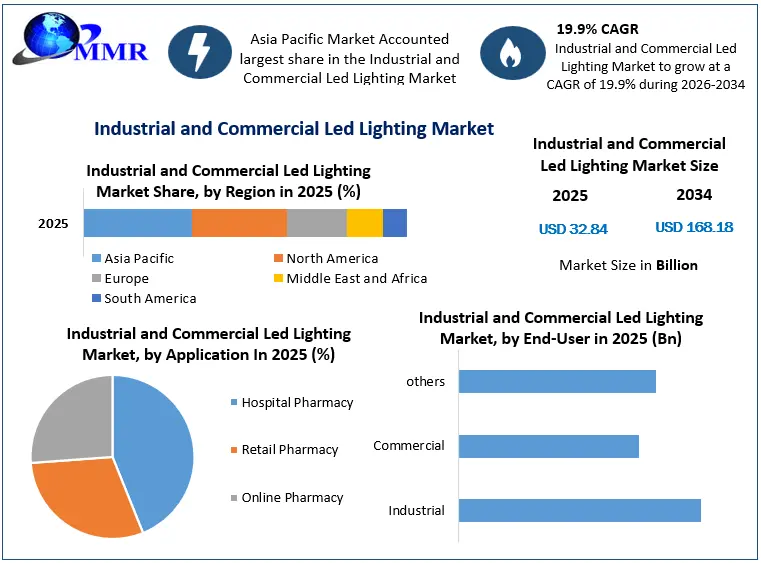
- Market valued at USD 32.84 billion in 2025.
- Expected to reach USD 168.18 billion by 2034.
- Forecast CAGR stands at 19.9% (2026–2034).
- Asia Pacific remains the largest regional market.
- Indoor lighting accounted for the leading distribution segment in 2025.
- Industrial and commercial facilities continue replacing conventional lighting with LED systems.
- Smart lighting controls and connected building technologies are becoming major investment priorities.
- Government energy-efficiency regulations continue to accelerate market adoption.
- Sustainability targets and carbon reduction commitments are influencing purchasing decisions across commercial infrastructure.
Why This Matters Now
Lighting accounts for a significant share of global electricity consumption and carbon emissions, making efficiency improvements an immediate business priority. Rising electricity prices, stricter sustainability regulations, and increasing investments in smart buildings are accelerating LED replacement projects worldwide. Organizations adopting intelligent LED lighting benefit from lower operating costs, reduced maintenance, and improved workplace productivity, strengthening the business case for rapid deployment.
Market Overview
The Industrial and Commercial LED Lighting Market includes LED lamps, luminaires, fixtures, and integrated lighting systems used across factories, warehouses, office buildings, retail outlets, healthcare facilities, and commercial infrastructure. The market also covers connected lighting platforms that integrate sensors, automation, and energy management technologies.
Demand is primarily driven by the transition away from conventional lighting technologies toward highly efficient LED solutions. Compared with fluorescent, HID, and incandescent systems, LED lighting offers substantially lower electricity consumption, longer operating life, reduced maintenance requirements, and improved lighting quality.
Government policies promoting energy conservation continue to support widespread adoption. Many countries have introduced regulations encouraging high-efficiency lighting installations to reduce electricity demand and lower greenhouse gas emissions. These initiatives are increasing retrofit projects across existing commercial buildings while encouraging LED integration into new infrastructure developments.
Supply dynamics are also improving as manufacturers expand product portfolios with smart controls, higher lumen efficiency, and connected lighting capabilities. Growing investments in commercial construction, logistics facilities, manufacturing plants, and industrial modernization further strengthen long-term demand.
Key Trends Driving Growth
Smart Lighting Becomes the Next Competitive Standard
Commercial customers increasingly demand lighting systems capable of remote monitoring, occupancy sensing, daylight harvesting, and centralized energy management. Connected lighting enables facility operators to reduce electricity consumption while improving operational efficiency.
Government Energy Regulations Support Adoption
National energy-efficiency programs continue encouraging replacement of conventional lighting with LED technologies. Public-sector projects, commercial infrastructure upgrades, and industrial modernization programs are creating sustained demand across multiple regions.
Sustainability and Circular Economy Initiatives Expand
Manufacturers are increasingly introducing recyclable materials, lower-carbon manufacturing processes, and circular product strategies. Sustainability has become an important purchasing criterion for commercial buyers seeking to meet ESG commitments.
Innovation Focuses on Higher Efficiency
Manufacturers continue improving thermal management, lumen output, optical performance, and product durability. These innovations reduce total ownership costs while extending product lifespan in demanding industrial environments.
Building Automation Drives Market Expansion
LED lighting increasingly functions as part of broader smart building ecosystems. Integration with building management systems enables predictive maintenance, occupancy analytics, and optimized energy consumption across commercial facilities.
Explore detailed analysis, insights, and growth opportunities
Segment Insights
Dominant Segment: Indoor Lighting
Indoor lighting remained the largest distribution segment during 2025 due to extensive deployment across offices, factories, warehouses, healthcare facilities, educational institutions, and retail spaces.
Businesses increasingly prioritize indoor LED upgrades because lighting represents one of the largest operating expenses in commercial buildings. Modern LED systems reduce electricity costs while minimizing maintenance interruptions through longer service life.
Business Impact: Facility owners benefit from lower operational expenditure, improved employee productivity, and compliance with evolving energy-efficiency regulations, making indoor lighting the primary investment category.
Fastest-Growing Segment: Smart Commercial LED Lighting
Although traditional LED installations continue expanding, intelligent lighting solutions integrated with sensors, wireless controls, and building automation systems represent the fastest-growing opportunity.
Commercial customers increasingly seek data-driven lighting infrastructure capable of reducing energy waste while supporting digital building management strategies.
Business Impact: Smart lighting creates recurring revenue opportunities through software, controls, maintenance, and connected services beyond hardware sales.
Additional Key Sub-Segments
LED Lamps
Demand remains strong due to widespread retrofit projects replacing legacy lighting systems without major infrastructure modifications. This segment offers an economical transition pathway for commercial customers.
LED Luminaires
LED luminaires continue gaining market share because integrated systems provide superior efficiency, optical performance, and durability compared with standalone lamp replacements.
Industrial End Users
Manufacturing facilities, logistics centers, and warehouses increasingly invest in high-output LED solutions that improve workplace safety while reducing electricity consumption.
Commercial End Users
Retail stores, office buildings, hospitality facilities, and institutional infrastructure continue expanding LED adoption to lower operating expenses and improve customer experience through enhanced lighting quality.
Regional Growth Story
Asia Pacific
Asia Pacific accounted for the largest market share in 2025 and is expected to maintain the strongest growth trajectory throughout the forecast period. Rapid industrialization, expanding commercial infrastructure, urban development, and supportive government energy policies continue driving LED deployment. Manufacturing capacity across the region also strengthens supply competitiveness.
North America
North America remains a mature but innovation-driven market. Organizations continue replacing legacy lighting with intelligent LED systems integrated into smart building platforms. Investments in warehouse automation, commercial real estate modernization, and industrial digitization support sustained demand.
Europe
Europe benefits from stringent environmental regulations, ambitious carbon reduction targets, and increasing investments in sustainable commercial buildings. Demand increasingly favors premium lighting systems offering higher efficiency and circular economy features.
Middle East, Africa, and Latin America
These regions remain at earlier stages of LED adoption but offer substantial long-term opportunities. Infrastructure development, urbanization, and government modernization programs are gradually expanding commercial LED deployment across emerging economies.
Competitive Landscape
Competition is increasingly centered on product innovation, connected lighting capabilities, sustainability performance, and specialized industrial applications rather than price alone.
Signify continues strengthening its market position through sustainability initiatives and smart lighting innovation, reinforcing its leadership in professional lighting solutions.
Acuity Brands Lighting focuses on high-performance industrial and architectural lighting products, improving efficiency and visual performance for demanding commercial environments.
Cooper Lighting Solutions is expanding its connected lighting ecosystem through advanced interoperability while strengthening hazardous-location capabilities following strategic acquisitions.
ams OSRAM, Zumtobel Group, Dialight, GE Current, Cree LED, Toshiba Corporation, Syska LED Lights, Eaton Corporation, General Electric, and DECO Enterprises continue competing through specialized industrial solutions, product diversification, and integrated lighting systems that address evolving commercial requirements.
Recent Developments
- May 2026: Lithonia Lighting introduced the Beyond LED High Bay featuring patent-pending thermal technology and record high-lumen output for industrial facilities.
- April 2026: Cooper Lighting Solutions launched WaveLinx DALI, enabling seamless integration of DALI-2 certified lighting controls within connected building ecosystems.
- March 2026: Signify launched its Brighter Lives, Better World 2030 program, targeting lower portfolio carbon emissions and higher circular product revenues.
- November 2025: Cooper Lighting Solutions acquired Nemalux, expanding its hazardous-location industrial lighting portfolio.
- August 2025: Acuity Brands Lighting secured multiple selections in the 2025 IES Progress Report, highlighting advancements in industrial LED efficiency and optical performance.
Future Outlook
Companies combining intelligent lighting platforms, sustainability leadership, and high-performance industrial solutions will capture the strongest competitive advantage as commercial infrastructure rapidly transitions toward fully connected, energy-efficient lighting ecosystems.
Analyst Perspective- Dharti Raut
The Industrial and Commercial LED Lighting Market is moving beyond a simple replacement cycle and becoming a strategic component of smart infrastructure. While energy savings remain the primary purchasing driver, buyers are increasingly evaluating lighting systems based on connectivity, automation, and long-term operational efficiency. This shift is expanding revenue opportunities for manufacturers that can integrate LED hardware with intelligent controls and building management platforms.
About Maximize Market Research
Maximize Market Research Pvt. Ltd. (MMR) is a global market research and consulting company that provides reliable, data-focused, and practical business insights. The firm serves a wide range of industries, including healthcare, pharmaceuticals, technology, automotive, electronics, chemicals, personal carec, and consumer goods. Through market forecasts, competitive analysis, strategic consulting, and industry impact assessments, MMR helps organizations understand changing market conditions, identify growth opportunities, and make informed business decisions for long-term success.
Contact Us :
2nd Floor, Navale IT Park Phase 3
Pune Banglore Highway, Narhe
Pune, Maharashtra 411041, India
+91 9607365656
[email protected]