
Key Highlights
-
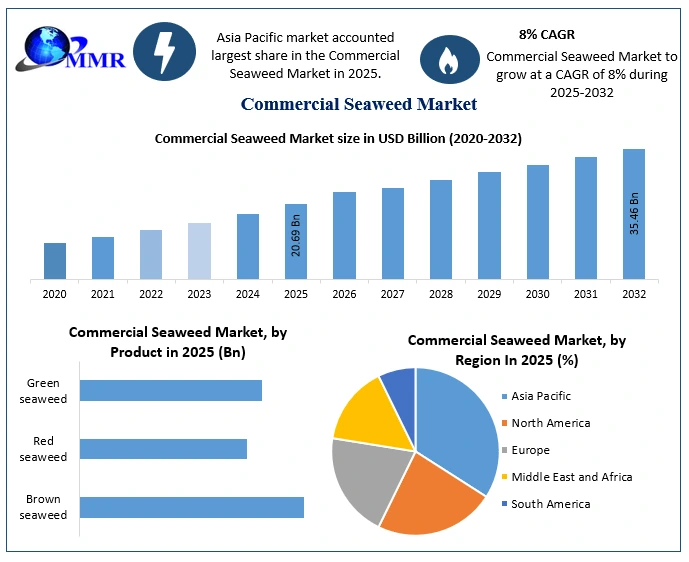
Market Valuation: Scaled from USD 20.69 billion in 2025 to a forecasted USD 35.46 billion by 2032.
-
Sustained Velocity: The market exhibits an 8% CAGR driven by non-linear demand across food, cosmetics, and pharmaceuticals.
-
Regional Dominance: Asia Pacific controls over 60% of global market share, serving as the epicenter for raw materials and processing.
-
Core Segment Leader: Brown seaweed remains the most widely cultivated and consumed global variety.
-
Strategic Growth Vector: Advanced cultivation practices like bioreactors and offshore farming are expanding production yields.
-
Infrastructure Urgency: Industry players are aggressively deploying automated processing infrastructure to counter quality variability and raw material volatility.
Why This Matters Now
Volatile environmental conditions and unpredictable crop yields are forcing a paradigm shift in industrial seaweed processing. Legacy operations rely on manual handling, which introduces massive inconsistencies in extract grading and processing times. To maintain strict regulatory compliance across global food and pharmaceutical supply chains, operators are pivoting toward smart manufacturing initiatives.
Integrating process optimization technologies has evolved from a long-term capital strategy to an immediate operational requirement. Factories that do not digitize face compressed margins due to raw material spoilage and competitive obsolescence. The convergence of industrial IoT adoption and automated processing infrastructure is reshaping how marine biomass is refined into high-value compounds.
Market Overview
The global commercial seaweed market Size is scaling rapidly as downstream industries demand stable, plant-based thickeners, stabilizers, and bioactive compounds. According to data from Maximize Market Research, the global market was valued at USD 20.69 billion in 2025. Driven by an 8% CAGR, total revenue is projected to reach USD 35.46 billion by 2032. This multi-billion-dollar surge creates an expanding operational landscape for industrial automation providers and system integrators.
Extracting hydrocolloids such as carrageenan, alginates, and agar requires precision-controlled environment parameters. Seaweed-derived additives require exact thermal profiles and chemical balances during refinement. Minor deviations in processing temperatures diminish gelling properties and ruin entire batches. As global demand outpaces manual throughput caps, processing facilities are digitizing their operational technology (OT) to secure predictable yields and eliminate human error.
Key Trends Driving Growth
A primary catalyst within the market is the massive adoption of seaweed-based ingredients as plant-based meat and dairy alternatives. This shift exposes processing plants to rigorous corporate quality standards and unpredictable demand spikes. To handle this volume safely, manufacturers are deploying advanced processing technology to improve raw material extraction and refinement efficiency.
Simultaneously, the industry is shifting toward next-generation cultivation techniques, including offshore farming and highly controlled bioreactors. Bioreactor deployment introduces complex industrial automation trends, including automated nutrient dosing, real-time pH monitoring, and closed-loop feedback systems. These automated cultivation spaces require synchronized process control systems to stabilize raw material characteristics before the seaweed even reaches the refinery floor.
Segment Insights
-
Dominant Segment: Brown seaweed represents the most widely cultivated and consumed product type globally, serving as the foundational source for industrial alginates used extensively as thickeners and emulsifiers across multi-industry manufacturing operations.
-
Alternative Inputs: Red seaweed maintains critical market share due to its role in high-demand food-grade carrageenan production, while green seaweed is increasingly harvested for targeted food products and specialized bioactive compounds.
-
Form Factors: Powdered seaweed represents the leading form factor for food and beverage application integration, whereas liquid extracts dominate cosmetics and personal care manufacturing pipelines.
-
Fastest-Growing Segment: The pharmaceutical and nutraceutical application segments are expanding rapidly, requiring manufacturers to install high-end instrumentation, cleanroom automation, and continuous validation architectures.
Regional Growth Story
The Asia Pacific region functions as the definitive powerhouse of the commercial seaweed market, commanding over 60% of total global market share. Industrial clusters across China, Japan, and South Korea deploy large-scale seaweed farming and processing infrastructure to sustain massive food and industrial ingredient pipelines. The shear volume processed in these nations is driving extensive investments in automated manufacturing systems to boost labor productivity and minimize processing losses.
In contrast, North America and Europe are emerging as major consumption hubs for premium seaweed-based products. The United States is the largest marketplace in North America, while France, Ireland, and Norway serve as the primary processing and harvesting hubs within Europe. These Western markets are prioritizing highly automated, data-driven processing facilities to counteract elevated regional labor costs and strictly enforce stringent European and American food safety regulations.
Competitive Landscape
The global commercial seaweed market is highly competitive and fragmented, forcing top-tier players to aggressively modernize their production assets. Enterprise leaders, including Cargill, DuPont (E.I. du Pont de Nemours and Company), Gelymar, Qingdao Gather Great Ocean, Roullier Group, Seaweed Energy Solutions, and Seasol International, are executing multi-layered expansion strategies. These market leaders are continuously broadening product portfolios and scaling total production capacities to secure pricing advantages and expand global footprints.
To maintain market share, these companies are shifting away from standalone processing assets toward unified plant environments. For example, specialized entities like Gelymar focus exclusively on carrageenan optimization, while Qingdao Gather Great Ocean produces diversified portfolios including agar, carrageenan, and alginate. This specialization signals a broader industry transition: market dominance no longer relies solely on harvesting capacity, but on the software-driven efficiency, speed, and precision of a company’s refining infrastructure.
Recent Developments
-
Market participants are systematically expanding their production portfolios through targeted mergers, acquisitions, and cross-border partnerships to solidify local supply chains.
-
Processors are investing heavily in advanced infrastructure to extract high-purity ingredients demanded by western pharmaceutical and nutraceutical buyers.
-
Cultivators are commercializing offshore farming and automated bioreactor technologies to insulate raw material sourcing from changing oceanic conditions.
-
Top-tier ingredient manufacturers are embedding automated tracking and quality grading systems into their intake facilities to isolate batch anomalies instantly.
Strategic Implications
For plant managers and operations executives, the growth of the seaweed market demands an immediate modernization of factory-floor control architectures. Relying on fragmented, disconnected processing machines limits yield transparency and exposes manufacturers to severe compliance liabilities. Integrating reliable automation allows operators to dynamically adjust refining parameters based on the incoming material’s precise moisture levels and organic composition.
Furthermore, deploying unified supervisory systems bridges the gap between field-level processing equipment and enterprise-level resource planning. Scaling production from pilot plants to high-volume commercial facilities requires reliable recipe management and automated material handling. Manufacturers that master data-driven process controls will capture high-margin supply contracts by proving they can deliver consistent material specifications batch after batch.
Future Outlook
The next phase of evolution within the commercial seaweed market will be defined by the complete digitization of the raw-material-to-extract pipeline. As production volumes hit historic highs, traditional manual operations will face unsustainable asset wear and costly batch rejections. Plant operators who embed automated controls, real-time sensing, and end-to-end process visibility will establish an unassailable edge in operational agility and product quality. The industry is dividing along a clear technological fault line: forward-thinking enterprises that deploy scalable smart manufacturing systems will dominate global ingredient supply chains, while legacy operators relying on manual processing will be squeezed out by volatile margins and strict regulatory thresholds.
Analyst Perspective
“The commercial seaweed market is experiencing an unprecedented industrial inflection point,” states Sidhhi Dole, Research Analyst at Maximize Market Research. “As multi-industry demand for high-purity marine extracts accelerates, processing facilities can no longer tolerate the quality fluctuations inherent in manual operations. The future of this market belongs entirely to producers who aggressively integrate advanced process automation and unified digital controls to guarantee reliable, scaled output.”
About Maximize Market Research
Maximize Market Research Pvt. Ltd. (MMR) is a global market research and consulting company that provides reliable, data-focused, and practical business insights. The firm serves a wide range of industries, including healthcare, pharmaceuticals, technology, automotive, electronics, chemicals, personal care, and consumer goods. Through market forecasts, competitive analysis, strategic consulting, and industry impact assessments, MMR helps organizations understand changing market conditions, identify growth opportunities, and make informed business decisions for long-term success.
2nd Floor, Navale IT Park Phase 3
Pune Banglore Highway, Narhe
Pune, Maharashtra 411041, India
+91 9607365656
[email protected]