Global Contraceptive Drugs and Devices Market Driven by Next-Generation Contraceptive Solutions

Key Highlights:
-
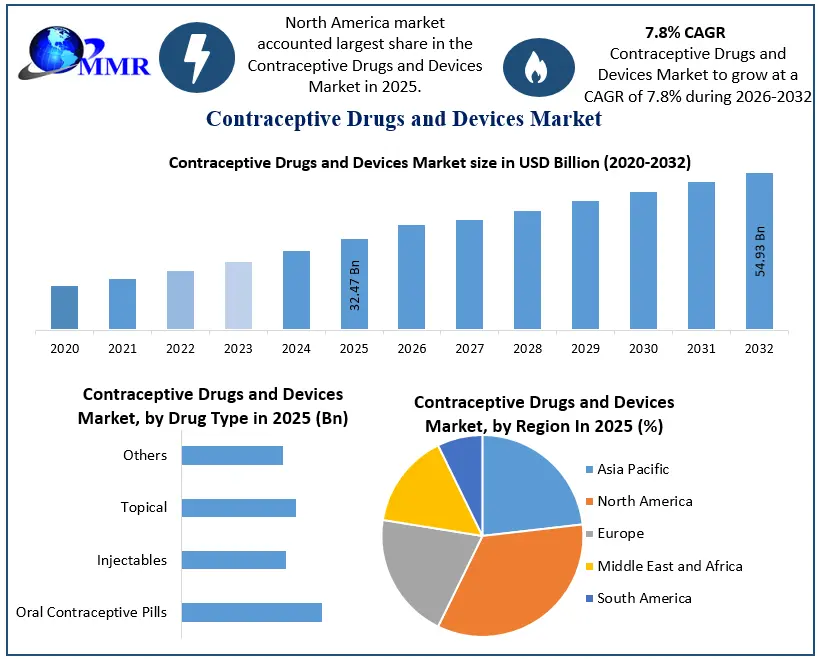
Global market valuation reached USD 32.47 billion in 2025 and is projected to scale to USD 54.93 billion by 2032, maintaining a 7.8% CAGR.
-
Contraceptive drugs held the largest product segment share in 2024, driven by widespread global consumption of oral pills.
-
Female end users dominated the market in 2024 due to an extensive portfolio of long-acting and short-term female-directed interventions.
-
North America led global revenue generation in 2025, supported by public family planning initiatives and structured insurance reimbursement frameworks.
-
The Asia-Pacific region accounted for approximately 10% of global sales in 2023, emerging as a high-volume market driven by expanding population density.
-
Clinical validation studies show a 75% overall contraception prevalence rate in specific surveyed communities, with tubectomies and intrauterine devices leading adoption.
Why This Matters Now
Hospital networks, public health agencies, and medical device manufacturers face immediate operational pressures as global regulatory shifts accelerate the approval of long-acting reversible contraceptives (LARCs) and hormone-free intrauterine systems (IUS). Procurement strategies must transition away from legacy, high-dose hormonal therapies toward next-generation biomaterial platforms that minimize patient side effects and reduce clinical complication liabilities. Healthcare organizations that fail to adjust their clinical formularies to incorporate these rapid innovations will lose patient volume to modern, consumer-centric telehealth platforms and specialized reproductive health networks.
The business imperative requires medical technology companies to redesign product offerings around long-term compliance and localized tissue compatibility. Regulatory updates, such as public insurance listings and newly approved low-dose metal-alloy frameworks, are lowering the financial and anatomical barriers to long-term clinical adoption. For healthcare executives and institutional purchasing groups, these advancements present clear opportunities to improve patient safety metrics, stabilize outpatient supply chains, and build value-based care pathways that lower the total cost burden of unplanned pregnancies.
Market Overview
The global Contraceptive Drugs and Devices Market comprises therapeutic formulations and mechanical instruments utilized by healthcare providers to prevent unintended pregnancies and limit the transmission of reproductive illnesses. The market includes short-acting oral pills, long-acting subdermal implants, injectable formulations, and intrauterine systems distributed across retail pharmacies, public clinics, and hospital networks. MMR forecasts the global contraceptive drugs and devices market to expand from USD 32.47 billion in 2025 to nearly USD 54.93 billion by 2032, demonstrating a 7.8% CAGR.
The commercial scaling of this sector is directly tied to shifts in global population demographics and evolving disease prevention protocols. Public data from the Journal of Family Medicine and Primary Care highlights a localized contraceptive prevalence rate of 75% within surveyed health ecosystems. Within these documented clinical environments, tubectomies accounted for an 81.6% share, followed by intrauterine devices at 6.3% and oral contraceptive pills at 0.7%. For medical device suppliers and pharmaceutical developers, this baseline distribution emphasizes a substantial commercial opening to displace permanent surgical interventions with highly reversible, long-acting medical instruments.
Key Trends Driving Growth
Clinical demand is shifting rapidly from standard daily oral pills toward long-acting reversible contraceptives that decouple clinical efficacy from patient adherence. Traditional oral regimens present high failure rates in real-world environments due to missed doses, creating an opportunity for subdermal implants and intrauterine systems that offer multi-year protection. This shift optimizes hospital clinical workflows by minimizing repetitive outpatient consultations and stabilizing long-term device procurement forecasts.
Public health initiatives and supportive regulatory updates form the second major market driver. Regional governments are expanding public insurance coverage to encompass advanced reproductive technologies, lowering out-of-pocket costs for patients. For example, Organon secured public insurance listings for its NEXPLANON etonogestrel extended-release subdermal implant under the Régie de l’assurance maladie du Québec (RAMQ). These structural updates integrate long-acting contraceptive hardware directly into public healthcare budgets, driving predictable, high-volume procurement contracts for manufacturers.
Biomaterial innovation represents the third primary trend reshaping the competitive landscape. The market has moved beyond legacy high-dose copper and rigid plastic matrices toward highly flexible, low-dose metal alloys and targeted hormonal delivery systems. These material advancements minimize systemic side effects, lower the incidence of localized tissue irritation, and substantially reduce device expulsion rates during clinical procedures. Consequently, healthcare provider networks are restructuring their procurement criteria to prioritize manufacturers that leverage advanced material science to improve long-term patient tolerance.
Segment Insights
-
Contraceptive Drugs (Dominant Product Segment): The contraceptive drugs segment held the largest market share in 2024. Within this category, oral contraceptive pills captured the leading position due to widespread, established global retail distribution and high familiarity across both developed and emerging clinical sectors.
-
Female End Users (Dominant End User Segment): Female end users dominated the global market in 2024. This concentration exists because the majority of modern, highly effective contraceptive methods—including intrauterine systems, implants, vaginal rings, injectables, and emergency pills—are explicitly engineered for female anatomy and clinical management.
-
Intrauterine Devices (Significant Growth Segment): Intrauterine systems and long-acting devices are growing rapidly within the broader hardware portfolio. These options are favored by hospital networks due to their multi-year efficacy profiles and strong safety metrics under clinical tracking.
-
Fastest-Growing Segment: The supplied MMR report does not specify a separate fastest-growing segment by product sub-type, end-user demographic, or institutional distribution channel. Unspecified growth metrics are omitted to maintain strict reporting compliance.
Regional Growth Story
North America maintained its position as the largest regional market in 2025. This leading market position is sustained by high consumer clinical awareness, structured family planning infrastructure, and supportive government regulations that mandate commercial health insurance providers to cover reproductive health devices without consumer cost-sharing. This regulatory environment allows medical device manufacturers to launch premium, high-unit-cost intrauterine systems and implants with clear assurance of clinical reimbursement.
The United States is analyzed within the North American regional boundary. The report does not break out standalone US funding metrics, state-level procurement mandates, or specific commercial payer allocation splits.
The Asia-Pacific region represents a high-potential volume opportunity, accounting for approximately 10% of global sales in 2023. Regional demand is driven by rapid population growth and expanding public initiatives aimed at strengthening reproductive health infrastructure across urban and rural environments. China, India, and Japan remain primary volume drivers within this zone, as local health ministries scale up their distribution contracts for automated clinical supplies and affordable oral pharmaceuticals.
Competitive Landscape
The global contraceptive drugs and devices market features prominent consolidation among established multinational operators, including Pfizer Inc., Merck & Co., Inc., Teva Pharmaceuticals Ltd., Agile Therapeutics, Inc., Allergan plc, Ani Pharmaceuticals Inc., Church & Dwight Co., Inc., and Fuji Latex Co., Ltd. These organizations are pivoting their commercial strategies away from baseline manufacturing toward co-developing novel delivery systems alongside specialized women’s health firms. This collaborative framework allows major players to capture proprietary biomaterial designs and defend their market share against generic pharmaceutical duplication.
This competitive environment signals a broader shift in institutional purchasing habits and technology leadership. For example, Sebela Pharmaceuticals Inc. partnered with PRA Health Sciences to execute a comprehensive Phase III clinical trial evaluating LevoCept, a long-acting reversible intrauterine system designed to optimize safety and tolerability. By subjecting new hardware to rigorous clinical trial scrutiny, leading manufacturers are positioning their products to meet the value-based purchasing criteria used by major hospital group purchasing organizations (GPOs).
Recent Developments
-
On 24 February 2025, Sebela Women’s Health Inc. secured U.S. FDA approval for MIUDELLA, a next-generation, hormone-free copper intrauterine system indicated for pregnancy prevention for up to three years. This represents the first hormone-free copper IUD approved in the United States in over 40 years, utilizing a flexible nitinol frame to deliver effective contraception with less than half the copper dose of legacy alternatives.
-
On 25 February 2025, Daré Bioscience and Theramex advanced their commercial alignment to scale up the international distribution of novel localized contraceptive delivery systems across primary global healthcare markets.
Strategic Implications
The approval of next-generation devices like MIUDELLA alters the financial dynamics of institutional healthcare procurement. By introducing a flexible nitinol framework that contains less than half the copper volume of legacy products, manufacturers have addressed the primary clinical cause of device discontinuation: localized pain and bleeding. For hospital procurement teams, stocking these optimized, lower-dose systems reduces subsequent emergency clinic visits for device removal, directly improving institutional efficiency metrics under value-based insurance plans.
Furthermore, the expansion of public insurance coverage for subdermal implants requires clinical networks to modernize their clinician training programs. Hospital systems must ensure that outpatient staff are fully certified in modern, minimally invasive insertion and removal techniques for long-acting hardware. This educational investment allows clinical networks to maximize the utilization of reimbursed devices, strengthening their competitive position against direct-to-consumer digital health startups that lack physical procedural capabilities.
Future Outlook
The global contraceptive drugs and devices market will undergo a deep transformation as non-hormonal, long-acting biomaterials displace traditional systemic medications. Over the forecast period, the reliance on high-dose daily oral contraceptives will decline as healthcare providers prioritize long-acting reversible systems that integrate seamlessly into outpatient reproductive workflows. Regional public health networks will increasingly tie their procurement contracts to long-term patient compliance data and localized safety profiles.
The market will split into clear competitive tiers based on material innovation and regulatory adaptability. Future medical technology leaders will be defined by their ability to commercialize flexible, low-dose, or hormone-free intrauterine systems that minimize clinical side effects, while market laggards will remain restricted to high-dose generic pharmaceuticals that fail to meet modern value-based healthcare standards.
Analyst Perspective
“The introduction of advanced materials like nitinol frames in hormone-free intrauterine systems marks the end of a forty-year stagnation in device design,” stated Komal Patil, Lead Analyst at Maximize Market Research. “Modern hospital procurement teams are looking beyond initial product costs to evaluate total patient retention rates, favoring long-acting devices that eliminate consumer compliance errors and drastically reduce clinical return rates.”
About Maximize Market Research
Maximize Market Research Pvt. Ltd. (MMR) is a global market research and consulting company that provides reliable, data-focused, and practical business insights. The firm serves a wide range of industries, including healthcare, pharmaceuticals, technology, automotive, electronics, chemicals, personal care, and consumer goods. Through market forecasts, competitive analysis, strategic consulting, and industry impact assessments, MMR helps organizations understand changing market conditions, identify growth opportunities, and make informed business decisions for long-term success.
2nd Floor, Navale IT Park Phase 3
Pune Banglore Highway, Narhe
Pune, Maharashtra 411041, India
+91 9607365656
[email protected]