
Key Highlights
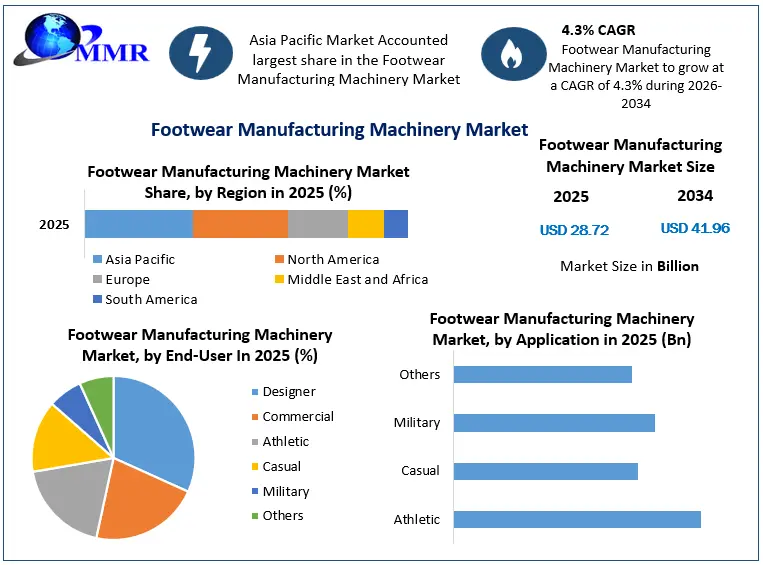
- Global Footwear Manufacturing Machinery Market valued at USD 27.54 billion in 2024.
- Market projected to reach USD 38.57 billion by 2032.
- Forecast CAGR stands at 4.3% between 2025 and 2032.
- Asia-Pacific held the largest market share in 2024.
- Automation, robotics, AI quality control, and IoT-enabled machinery are accelerating adoption.
- China, India, and Vietnam remain the center of global footwear production.
- Sustainability requirements are driving investment in energy-efficient and recyclable production technologies.
- Customization and 3D printing are emerging growth opportunities.
Why This Matters Now
Manufacturers are facing growing pressure to deliver footwear faster, cheaper, and with greater customization. At the same time, labor shortages, sustainability mandates, and rising consumer expectations are forcing production facilities to modernize.
The result is a new investment cycle across footwear manufacturing. Machinery suppliers capable of delivering automation, digitalization, and production flexibility are gaining strategic importance as footwear brands seek to protect margins while shortening product development cycles.
Market Overview
The global Footwear Manufacturing Machinery Market was valued at USD 27.54 billion in 2024 and is expected to reach nearly USD 38.57 billion by 2032, expanding at a CAGR of 4.3% during the forecast period.
Footwear manufacturing machinery includes equipment used for pattern making, cutting, stitching, molding, finishing, repair, testing, and component preparation. These systems enable mass production while improving precision, consistency, and production efficiency.
Market momentum is being driven by rising footwear demand worldwide, particularly across Asia-Pacific. According to the report, more than 22 billion pairs of footwear were produced globally in 2024, with Asia accounting for nearly 87% of total production. That concentration of manufacturing activity is creating sustained demand for advanced production equipment and factory modernization initiatives.
For manufacturers, the business case is increasingly clear. Automated machinery reduces waste, lowers labor dependency, improves throughput, and supports the flexibility needed to respond to rapidly changing consumer preferences.
Key Trends Driving Growth
Automation is becoming the defining competitive factor across footwear production facilities. Manufacturers are deploying robotic systems, automated cutting solutions, and digital workflow platforms to increase productivity while reducing operational variability.
AI-powered quality control is emerging as a major differentiator. Automated inspection systems improve defect detection, reduce material waste, and help manufacturers maintain consistent product quality across large production volumes. These capabilities are increasingly important as global brands tighten supplier performance requirements.
The integration of CAD/CAM technologies is also reshaping production economics. Digital design and manufacturing workflows shorten development cycles and allow producers to move from concept to commercialization more efficiently.
Sustainability is another major investment catalyst. Manufacturers are seeking machinery capable of reducing energy consumption, minimizing material waste, and supporting recyclable production processes. As environmental regulations tighten and brand sustainability commitments expand, equipment modernization is becoming a strategic necessity rather than a discretionary investment.
Customization represents an additional opportunity. The report identifies growing adoption of customized footwear production and 3D printing technologies, creating demand for machinery that combines flexibility with industrial-scale efficiency.
Need more information? Inquire about a sample report now
Segment Insights
- Dominant Segment: Not specified in the report.
- Fastest-Growing Segment: Not specified in the report.
- By Type: Pattern-making, cutting, finishing, molds, repair, component preparation, stitching machinery, laboratory testing machinery, and others.
- By Technology: Manual, semi-automatic, and fully automatic machinery.
- By Application: Athletic, casual, military, and other footwear categories.
- By End User: Designer, commercial, athletic, casual, military, and other segments.
The technology segmentation highlights the industry’s transition from labor-intensive production toward semi-automated and fully automated manufacturing environments. This shift is expected to influence future capital expenditure decisions across major footwear manufacturing hubs.
Regional Growth Story
Asia-Pacific remains the undisputed center of the global footwear manufacturing ecosystem. The region held the largest market share in 2024 and continues to benefit from its dominant role in footwear production. China, India, and Vietnam remain critical manufacturing hubs supported by extensive supply chains, skilled labor availability, and large-scale production capacity.
China continues to play a central role due to its mature industrial base and extensive manufacturing infrastructure. India is emerging as an increasingly important growth market as domestic footwear demand expands alongside export-oriented production investments.
Vietnam remains a strategic production location for global footwear brands seeking manufacturing diversification while maintaining access to established supply chain networks.
Europe maintains relevance through technological leadership. Italian and German machinery manufacturers continue to compete through innovation, automation expertise, and premium manufacturing solutions.
North America remains a significant market for advanced production technologies, particularly among manufacturers seeking nearshoring opportunities and higher levels of production automation.
Competitive Landscape
Competition is increasingly centered on automation capability, digital integration, production flexibility, and sustainability performance.
Leading suppliers are positioning themselves around smart manufacturing solutions that combine robotics, IoT connectivity, AI-based monitoring, and digital production management. The competitive focus has shifted from standalone machinery sales toward integrated production ecosystems.
Key market participants include:
- Atom S.p.A.
- Comelz S.p.A.
- Elitron IPM S.r.l.
- DESMA Schuhmaschinen GmbH
- Persico Group
- Dongguan Kingstone Shoe-making Machinery Co., Ltd.
- Orisol Taiwan Ltd.
- Kou Yi Iron Works Co., Ltd.
- True Ten Industrial Co., Ltd.
- Guangdong Honggang Intelligent Equipment.
The concentration of major machinery suppliers in Italy, Germany, China, and Taiwan highlights the importance of engineering expertise and manufacturing specialization in shaping competitive positioning.
Recent Developments
- Growing deployment of AI-based quality control systems.
- Expansion of RFID-enabled production tracking solutions.
- Increasing integration of robotics into footwear assembly operations.
- Rising adoption of IoT-enabled machinery for factory monitoring.
- Greater investment in sustainable and energy-efficient manufacturing technologies.
- Increased focus on customization capabilities and 3D printing applications.
These developments indicate that the industry is moving toward highly connected and data-driven production environments.
Strategic Implications
For footwear brands, machinery modernization is becoming a source of competitive advantage. Faster production cycles allow brands to respond more effectively to changing consumer trends while reducing inventory risk.
For machinery suppliers, the opportunity extends beyond equipment sales. Digital services, predictive maintenance, software integration, and production analytics are creating recurring revenue opportunities.
For investors, the market’s growth trajectory highlights demand for industrial automation solutions tied directly to consumer goods manufacturing. Companies with strong automation portfolios and digital manufacturing capabilities are positioned to capture a larger share of future investment cycles.
Supply chain resilience is also becoming a strategic priority. Manufacturers are seeking production technologies that support flexibility, efficiency, and regional diversification as global sourcing strategies continue to evolve.
Future Outlook
The next phase of growth in the Footwear Manufacturing Machinery Market will be defined by automation, sustainability, digital manufacturing, and production flexibility, with leaders emerging from those able to combine intelligent technology with scalable manufacturing efficiency.
Analyst Perspective
“The footwear manufacturing industry is entering a technology-led transformation cycle. Automation, AI-enabled quality control, sustainable production systems, and digital manufacturing platforms are becoming essential investments for manufacturers seeking productivity gains and long-term competitiveness. Companies that modernize production capabilities today will be better positioned to capture future growth opportunities across global footwear markets.” — Dharati Raut, Analyst
About Maximize Market Research
Maximize Market Research Pvt. Ltd. (MMR) is a global market research and consulting company that provides reliable, data-focused, and practical business insights. The firm serves a wide range of industries, including healthcare, pharmaceuticals, technology, automotive, electronics, chemicals, personal care, and consumer goods. Through market forecasts, competitive analysis, strategic consulting, and industry impact assessments, MMR helps organizations understand changing market conditions, identify growth opportunities, and make informed business decisions for long-term success.
Contact Us
2nd Floor, Navale IT Park Phase 3
Pune Banglore Highway, Narhe
Pune, Maharashtra 411041, India
+91 9607365656
[email protected]