
Arc-based Plasma Lighting Market Growth Analysis with 2.87% CAGR Forecast Through 2033
The global lighting and illumination sector is undergoing a highly specialized transition, driven by the need for ultra-high-intensity, energy-efficient, and full-spectrum light sources across industrial, scientific, and entertainment applications. At the core of this transition is the Arc-based Plasma Lighting Market, an advanced technological segment that delivers exceptional luminous efficacy and precise color rendering that traditional incandescent and early-generation solid-state lighting struggle to match at scale.
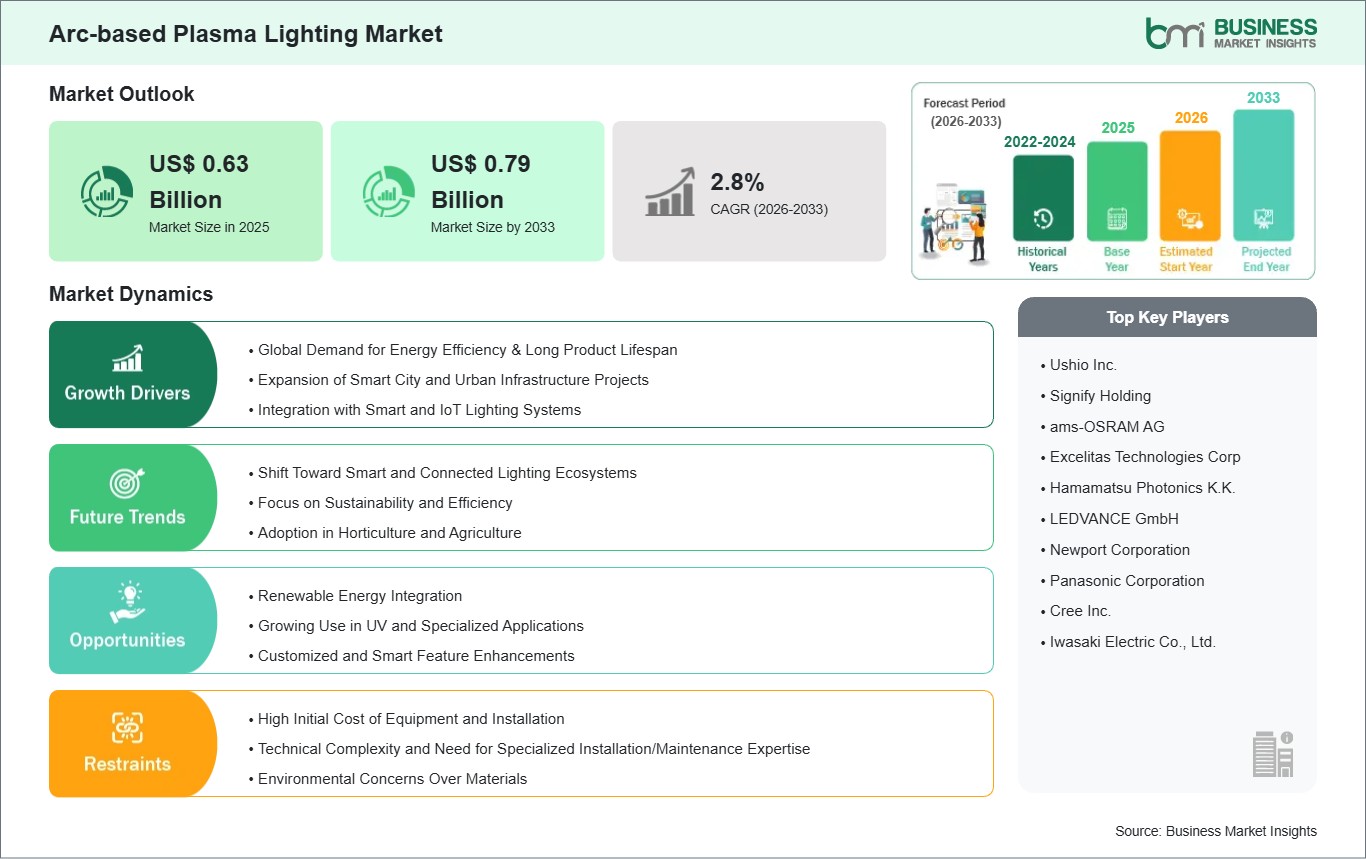
According to Business Market Insights, the global Arc-based Plasma Lighting Market size is expected to reach US$ 0.79 Billion by 2033 from US$ 0.63 Billion in 2025. The market is estimated to record a CAGR of 2.87% from 2026 to 2033.
As industries increasingly prioritize high-performance lighting that closely mimics natural sunlight, arc-based plasma systems have become indispensable. These specialized systems are heavily deployed in large-scale event projection, commercial horticulture, solar simulation testing, and complex medical spectroscopy. Capital investment within the industry is heavily focused on optimizing electrode design, reducing the operational thermal footprint, and integrating smart, automated ballasts to extend the functional lifespan of high-wattage plasma lamps.
What Is Arc-based Plasma Lighting?
Arc-based plasma lighting is an advanced, high-intensity illumination technology that generates light by ionizing a gas to create a plasma arc. Unlike traditional incandescent bulbs that use a heated filament, or standard LEDs that rely on solid-state diodes, arc-based lighting channels an electrical current through a highly pressurized gas mixture such as xenon, metal halides, or mercury vapor enclosed within a specialized quartz or ceramic bulb.
When the electrical arc passes through the gas, it vaporizes the internal elements into a plasma state, emitting a continuous and intensely bright spectrum of light. These systems are highly valued for their unparalleled brightness, deep tissue penetration in medical settings, and high Color Rendering Index (CRI), which makes the artificial light nearly indistinguishable from natural sunlight. Because they can project intensely focused beams over long distances without massive energy losses, they are heavily favored for architectural searchlights, cinema projectors, and specialized industrial manufacturing processes.
Download Sample Report: https://www.businessmarketinsights.com/sample/BMIPUB00033272
Market Drivers
A primary driver accelerating the global Arc-based Plasma Lighting Industry is the Growing Demand for High-Intensity, Energy-Efficient Illumination. Large outdoor venues, maritime ports, and industrial manufacturing plants require massive volumes of light to operate safely. Arc-based plasma lighting provides significantly higher lumen output per watt compared to legacy high-intensity discharge (HID) fixtures. Furthermore, modern plasma systems achieve equivalent illumination with approximately 40% to 50% lower power input, operating without complex water-cooling systems and offering significant improvements in facility energy efficiency.
The Expansion of Commercial Horticulture and Vertical Farming serves as another core driver. The agricultural sector is rapidly transitioning toward controlled environment agriculture (CEA). Arc-based plasma lamps particularly metal halide and xenon variants emit a full, continuous spectrum of light that includes critical ultraviolet (UV) and infrared wavelengths. This precisely replicates natural sunlight, which is vital for optimizing plant photosynthesis, triggering robust vegetative growth, and ultimately securing higher crop yields in indoor farming environments.
Additionally, Widespread Adoption in Entertainment, Projection, and Medical Diagnostics acts as a major market catalyst. The global entertainment sector relies heavily on xenon arc lamps for digital cinema projectors and live-event stage lighting due to their pure white light and exceptional color fidelity. Concurrently, the medical and scientific sectors utilize customized deuterium and krypton arc lamps for complex spectroscopy, microscopic illumination, and highly targeted UV disinfection protocols.
Market Segmentation
By Light Source
- Metal Halide Lamps (Dominates the global market volume due to high luminous efficacy, long life, and broad spectral output, making them ideal for large-scale outdoor and stadium lighting)
- Xenon Arc Lamps (Captures a substantial market share and is the fastest-growing source, favored for providing a broad spectrum of light that closely mimics natural sunlight, heavily used in cinema projection and solar simulation)
- Deuterium Lamps (A niche but high-value segment, exclusively utilized in scientific instrumentation and UV spectroscopy)
- Krypton Arc Lamps (Highly specialized, utilized extensively for laser pumping in industrial laser cutting applications)
- Mercury Vapor Lamps (Maintaining a stable footprint in specialized industrial and environmental testing, though facing regulatory pressure due to toxicity concerns)
By Wattage Type
- 501 to 1500 W (Controls the largest revenue share, representing the standard operational sweet spot for industrial, commercial, and mid-tier architectural lighting)
- Above 1500 W (Expected to capture the highest forward growth rate, catering to applications necessitating exceptionally high-intensity illumination, such as global sports stadiums and large outdoor event venues)
- Below 500 W (Utilized primarily for targeted indoor medical lighting, laboratory microscopy, and localized UV sterilization units)
By Application
- Entertainment & Projection (Secures the primary market position, driven by consistent demand in theaters, live events, and large-screen projection systems)
- Horticulture & Agriculture (Experiencing rapid adoption as vertical farms integrate full-spectrum plasma arrays to boost photosynthetic photon flux density)
- Industrial & Outdoor Lighting (Propelled by smart city infrastructure modernization and the requirement for highly durable, harsh-environment lighting solutions)
- Searchlight & Spotlight (Sustained by military, maritime, and commercial aviation sectors requiring long-range visibility)
- Medical Lighting & Spectroscopy (A critical, high-margin application utilizing specialized arc frequencies for precise chemical analysis and surgical room illumination)
Regional Insights
- North America holds the premier position globally, driven by early adoption of state-of-the-art illumination technologies, a booming entertainment and cinematic industry in the United States, and heavy investments in smart agricultural infrastructure.
- Europe captures a substantial portion of global revenues, supported by strict energy-efficiency mandates, advanced industrial manufacturing sectors in Germany and the UK, and highly developed healthcare infrastructure requiring sophisticated medical lighting.
- Asia-Pacific is positioned as the fastest-accelerating geographic theater. Rapid industrialization, government-backed smart city initiatives, and the massive expansion of the semiconductor and electronics manufacturing sectors across China, Japan, and India heavily drive this regional surge.
- Rest of the World accounts for a progressive market share, fueled by large-scale infrastructure projects across the Middle East, smart stadium investments for global sporting events, and growing urban development in Latin America.
Get More Insights: https://www.businessmarketinsights.com/buy/BMIPUB00033272
Top Players in the Industry
The competitive ecosystem of the arc-based plasma lighting sector is highly consolidated, driven by specialized R&D requirements, complex quartz-manufacturing capabilities, and strict safety certifications.
- Signify Holding (Philips)
- ams-OSRAM AG
- Ushio Inc.
- Excelitas Technologies Corp.
- Hamamatsu Photonics K.K.
- LEDVANCE GmbH
- Agilent Technologies, Inc.
- Newport Corporation
- Superior Quartz Products, Inc.
- Iwasaki Electric Co., Ltd.
Strategic Industry Challenges
Despite significant operational advantages, the market faces intense competition from the rapidly evolving high-power LED (Light Emitting Diode) sector. While plasma lighting excels in ultra-high-intensity and true full-spectrum environments, solid-state LEDs have seen massive improvements in cost-efficiency and lifespan, frequently displacing lower-wattage plasma lamps in commercial applications. Furthermore, arc-based plasma systems require high initial capital investments for equipment installation, complex high-voltage electronic ballasts, and specific thermal management handling, which can deter adoption by smaller enterprises.
Future Market Outlook
The long-term trajectory for the Arc-based Plasma Lighting Market remains solid, particularly within high-intensity and specialized industrial niches where LED limitations are apparent. As the technology matures, the integration of solid-state RF microwave generators to ignite the plasma without traditional physical electrodes is expected to drastically increase lamp lifespan and reliability. The ongoing fusion of plasma technology with intelligent, IoT-enabled control networks will ensure its continued relevance across smart cities, advanced agriculture, and scientific research environments.
Frequently Asked Questions (FAQs)
What is the projected size of the global arc-based plasma lighting market by 2034?
The market is projected to reach an estimated valuation of USD 806.3 Million by 2034, growing from an established base of USD 636.5 Million in 2025.
Which light source segment dominates the market?
Metal Halide and Xenon Arc Lamps command the largest market shares due to their high luminous efficacy, excellent color rendering capabilities, and vast applicability across industrial lighting and cinema projection.
Why is arc-based plasma lighting highly valued in horticulture?
Plasma lighting emits a continuous, full-spectrum light (including beneficial UV and IR wavelengths) that closely mimics natural sunlight, which is highly effective for accelerating plant photosynthesis and improving indoor crop yields.
Browse More Reports:
Latin America Semiconductor Manufacturing Equipment Market
About Us
Business Market Insights is a market research platform that provides subscription service for industry and company reports. Our research team has extensive professional expertise in domains such as Aerospace & Defense; Automotive & Transportation; Electronics & Semiconductor; Energy & Power; Healthcare; Manufacturing & Construction; Food & Beverages; Chemicals & Materials; and Technology, Media, & Telecommunications.
Contact Us
If you have any questions about this report or would like further information, please contact us:
Contact person: Ankit Mathur
Email: [email protected]
Phone: +16467917070