Human Augmentation Market to Reach US$ 740.63 Billion by 2033 from US$ 244.95 Billion in 2025

The Human Augmentation Industry is undergoing a profound global transformation, shifting rapidly from specialized medical rehabilitation applications into broad industrial, commercial, and consumer adoption.
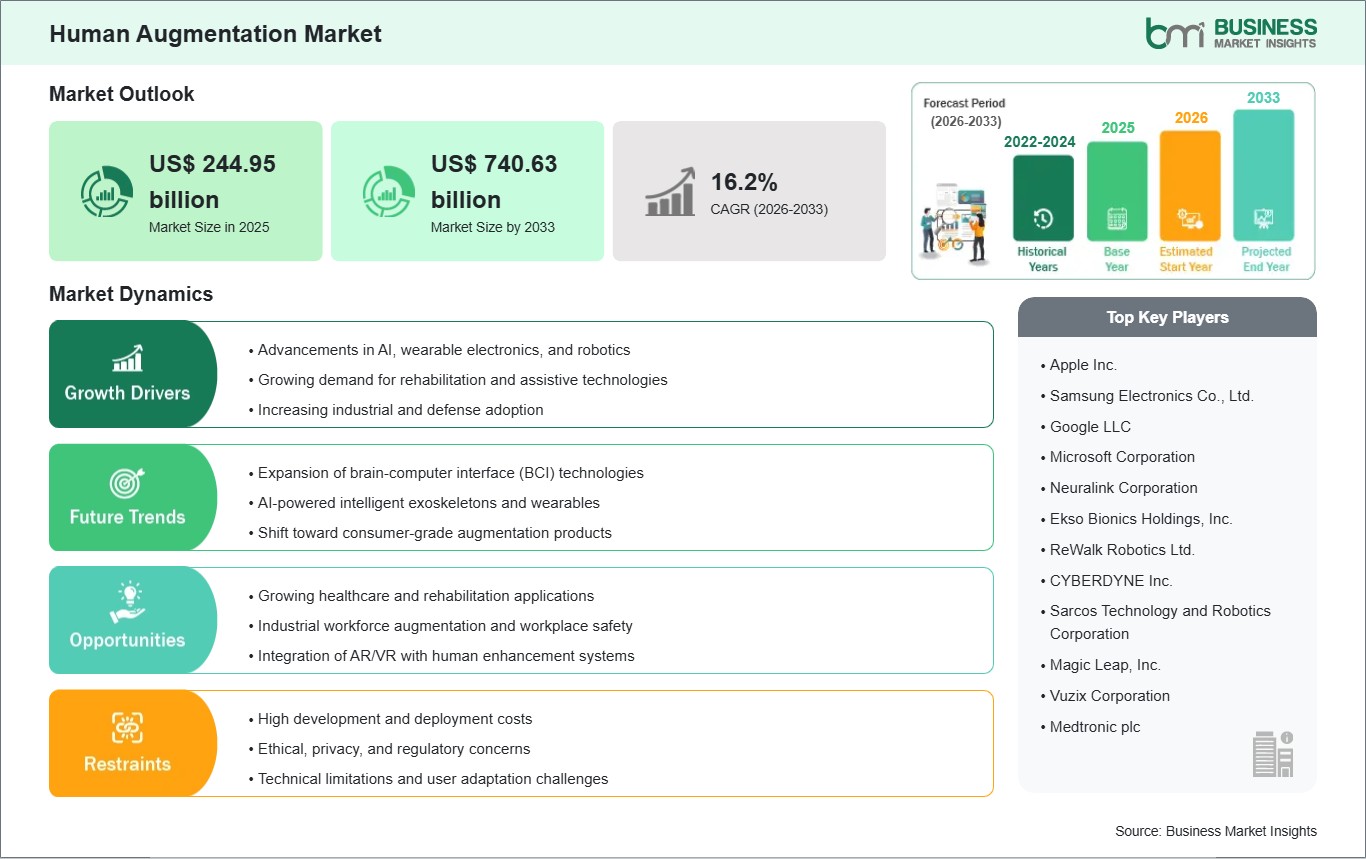
According to Business Market Insights, the global Human Augmentation Market size is expected to reach US$ 740.63 billion by 2033 from US$ 244.95 billion in 2025. The market is estimated to record a CAGR of 16.2% from 2026 to 2033.
Recent breakthroughs in non-invasive brain-computer interfaces (BCIs), high-torque lightweight materials for wearable robotics, and AI-driven predictive ergonomics are radically lowering implementation barriers. Major technology conglomerates, defense contractors, and specialized biomedical firms are aggressively channeling capital into research and development to deliver highly intuitive, interoperable systems that seamlessly blend autonomous machine intelligence with human decision-making workflows.
Download Sample Report : https://www.businessmarketinsights.com/sample/BMIPUB00035130
What Is Human Augmentation?
Human augmentation refers to a broad spectrum of engineering, medical, and technological innovations designed to temporarily or permanently enhance human capabilities beyond natural biological limitations. This interdisciplinary field encompasses physical augmentation, such as powered exoskeletons, bionic prosthetics, and smart orthotics; sensory augmentation, including augmented reality (AR) eyewear and advanced cochlear implants; and cognitive augmentation driven by brain-machine interfaces and AI-powered virtual performance assistants.
Unlike traditional assistive devices that merely restore lost functions, modern human augmentation systems focus on supplementing or exceeding normal human capacity. These systems utilize advanced biosignals, haptic feedback loops, and real-time data processing to establish an organic symbiosis between user intent and mechanical execution, allowing humans to operate with unprecedented speed, strength, and intellectual acuity.
Market Drivers
The foremost driver propelling the Human Augmentation Industry is the rising demand for enhanced industrial productivity and worker safety. In heavy manufacturing, logistics, and fulfillment centers, manual material handling causes severe ergonomic strain and repetitive injuries. By deploying powered and passive exoskeletons, companies can dramatically minimize worker fatigue, optimize posture, and reduce workplace injuries, thereby lowering corporate healthcare liabilities while boosting overall factory output.
Accelerating innovation within the healthcare and orthopedic sectors acts as another massive growth catalyst. The global aging demographic is driving unprecedented demand for advanced mobility solutions, bionic limbs, and robotic-assisted rehabilitation devices. Modern microprocessor-controlled prosthetics allow amputees to regain fluid, natural movement, significantly boosting independence and quality of life, which has led to widespread insurance coverage and public healthcare subsidies for these high-value technologies.
Furthermore, the rapid integration of Artificial Intelligence (AI) and the Internet of Things (IoT) is revolutionizing wearable tech. AI algorithms enable devices to learn an individual user’s unique biomechanical patterns or neural signatures, adjusting mechanical resistance or data streams dynamically. This adaptive functionality, paired with high-speed 5G connectivity, allows for seamless real-time performance monitoring across industrial and defense applications.
Additionally, aggressive defense and aerospace expenditures are fueling cutting-edge developments. Military agencies worldwide are heavily investing in tactical human augmentationranging from heads-up AR combat displays to high-endurance exosuitsto optimize situational awareness, reduce physical stress, and maximize the survival rates of personnel in demanding field operations.
Get More Details : https://www.businessmarketinsights.com/buy/BMIPUB00035130
Market Segmentation
By Product Type
- Wearable Devices (Smartwatches, Wristbands, Eyewear, Posture Correctors, Implants)
- Virtual Reality (VR) Devices
- Augmented Reality (AR) Devices
- Exoskeletons (Powered, Passive)
- Intelligent Virtual Assistants (IVAs)
By Functionality
- Body-Worn
- Non-Body-Worn
- Cognitive Augmentation
By Application / Vertical
- Healthcare & Medical
- Consumer Electronics
- Commercial & Industrial (Manufacturing, Logistics)
- Aerospace & Defense
- Energy & Utilities
The wearable devices and AR/VR segments currently account for a highly dominant share of market revenue, propelled by mass consumer adoption of smart personal tech and enterprise deployment of smart eyewear for remote maintenance. Concurrently, the exoskeleton segment is registering an exceptionally fast compound annual growth rate due to its rapid scaling across automotive assembly lines and geriatric rehabilitation centers. Geographically and historically, the healthcare sector remains the primary volume driver for high-precision implants and bionics.
Regional Insights
- North America holds a highly mature and dominant position in the global market, anchored by a thriving tech ecosystem, massive R&D investments from tech titans, robust venture capital funding for neural startups, and extensive Department of Defense contracts for advanced physical augmentation across the United States.
- Asia-Pacific is projected to witness the fastest regional growth rate during the forecast matrix. This rapid expansion is heavily driven by intense manufacturing automation initiatives, expanding healthcare infrastructures, and aggressive government-backed AI and robotics frameworks across China, Japan, South Korea, and India.
- Europe maintains a powerful market share, strongly underpinned by strict workplace safety and ergonomic regulations, robust public healthcare systems subsidizing advanced medical prosthetics, and a deep concentration of automotive and industrial engineering hubs utilizing exoskeleton technologies in Germany and France.
- Middle East & Africa and South & Central America are demonstrating steady, strategic progress, supported by rising digitization, modern healthcare infrastructure upgrades, and localized adoptions of wearable technology in corporate and military sectors.
Top Players in the Human Augmentation Industry
The global marketplace features concentrated competition among diversified consumer technology giants, medical device conglomerates, and agile robotics pioneers. Key industry participants focus heavily on improving battery density, optimizing neural decoding software, and ensuring strict data privacy for connected biometric devices.
- Samsung Electronics Co., Ltd.
- Google LLC (Alphabet Inc.)
- Microsoft Corporation
- Ekso Bionics Holdings, Inc.
- Cyberdyne Inc.
- Vuzix Corporation
- Apple, Inc.
- Meta Platforms, Inc.
- Neuralink Corporation
- ReWalk Robotics Ltd. (Lifeward)
These market leaders frequently execute high-profile mergers, fund academic neuro-engineering laboratories, and pursue stringent regulatory approvals (such as FDA clearances) to commercialize advanced medical-grade interfaces.
Technological Innovations
Technological innovations in Brain-Computer Interfaces (BCIs) are fundamentally shattering traditional computing paradigms. Emerging neural implants and non-invasive EEG caps are transitioning from laboratory testing into human trials, allowing individuals to control robotic limbs, digital cursors, and smart home environments purely through decoded thought patterns. This breakthrough is paving the way for thought spaces and immersive digital communication that completely bypasses physical screens or keyboards.
Furthermore, the launch of highly sophisticated software platforms, such as the Equisoft/amplify suite, highlights the rapid maturation of human-in-the-loop AI architectures. By blending advanced predictive analytics and autonomous AI agents with human decision-making workflows, these systems dramatically amplify human cognitive speeds, allowing analytical experts to process massive datasets and evaluate risks with unprecedented agility.
Additionally, the establishment of the international Human Augmentation Consortium has catalyzed a massive shift toward ecosystem interoperability and cross-industry standardization. This collaboration ensures that future exoskeletons, smart apparel, and sensory lenses can communicate seamlessly across completely different brand ecosystems and hardware infrastructures, accelerating mass commercial adoption across the manufacturing and healthcare sectors.
Future Market Outlook
The long-term trajectory for the Human Augmentation Industry remains exceptionally bright and highly disruptive. As microchip architectures become increasingly miniaturized and flexible electronics evolve, human augmentation will transition away from bulky, conspicuous external hardware toward discreet, everyday smart apparel and biocompatible implants that monitor health, regulate fatigue, and augment cognitive focus in real-time.
The upcoming integration of localized, low-latency edge AI will allow human augmentation devices to operate with absolute autonomy, anticipating a user’s movements or information needs before they even occur. As ethical frameworks materialize and regulatory pathways become standardized, human augmentation will evolve into a foundational pillar of the global workforce, dramatically optimizing human capability to match the accelerating pace of autonomous machinery and digital intelligence. Companies that successfully master lightweight materials, ultra-secure biometric software, and cross-platform compatibility will capture a commanding position in the human evolution market.
Frequently Asked Questions (FAQs)
What is the main difference between active (powered) and passive exoskeletons?
Active or powered exoskeletons utilize onboard batteries, electric motors, or pneumatic actuators to actively supply extra force and lift assistance to the user, making them ideal for heavy lifting or rehabilitation. Passive exoskeletons do not use any external power source; instead, they rely on springs, dampers, and counterweights to redistribute weight, capture kinetic energy from movement, and reduce muscle strain during repetitive tasks like overhead assembly.
How does AI improve the functionality of modern prosthetic limbs?
Traditional prosthetics require manual mode switching or rigid mechanical inputs. AI-powered prosthetics utilize advanced machine learning algorithms to analyze real-time data from electromyography (EMG) sensors placed on the user’s remaining muscle tissue. The AI instantly decodes the user’s subtle muscle twitches and electrical signals, predicting their exact intended movement (such as gripping a cup or climbing stairs) and executing it smoothly and naturally.
Are human augmentation technologies heavily regulated?
Yes, particularly those applied in the medical sector. Devices like bionic prosthetics, neural implants, and clinical exoskeletons are classified as medical devices and must undergo rigorous clinical trials and secure clearances from regulatory bodies like the US Food and Drug Administration (FDA) or European CE Mark before commercial sale. Industrial and consumer wearables are governed by strict ergonomic, electrical safety, and wireless data security standards.
What are Brain-Computer Interfaces (BCIs), and how close are they to consumer use?
BCIs are hardware and software systems that record brain activity (either through internal neural implants or external scalp sensors) and translate those electrical signals into commands that control digital devices or robotics. While invasive implants are currently limited to medical trials for paralyzed patients, non-invasive BCI headsets are rapidly entering the consumer and enterprise markets for hands-free gaming, attention monitoring, and cognitive research.
Browse More Reports:
https://www.businessmarketinsights.com/reports/gcc-graphite-market
https://www.businessmarketinsights.com/reports/africa-heavy-construction-equipment-market
https://www.businessmarketinsights.com/reports/europe-heavy-construction-equipment-market
About Us
Business Market Insights is a market research platform that provides a subscription service for industry and company reports. Our research team has extensive professional expertise in domains such as Electronics & Semiconductor; Aerospace & Defense; Automotive & Transportation; Energy & Power; Healthcare; Manufacturing & Construction; Food & Beverages; Chemicals & Materials; and Technology, Media, & Telecommunications.
Contact Us
If you have any questions about this report or would like further information, please contact us:
Contact person: Ankit Mathur
Email: [email protected]
Phone: +16467917070″