
Advances of 3D Printing in Healthcare Market Expected to Grow Rapidly as Personalized Medicine and Medical Innovation Expand

According to The Insight Partners – The global advances of 3D printing in healthcare market is experiencing remarkable growth as medical institutions, research organizations, and medical device manufacturers increasingly adopt additive manufacturing technologies to improve patient care and treatment outcomes. The growing demand for personalized medical solutions, rapid prototyping, and advanced surgical planning tools is driving the widespread integration of 3D printing across healthcare systems worldwide.
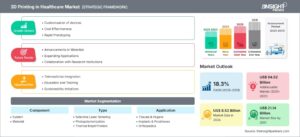
The 3D Printing In Healthcare Market size is expected to reach US$ 21.14 Billion by 2031. The market is anticipated to register a CAGR of 18.3% during 2025-2031.
Get Sample PDF @ https://www.theinsightpartners.com/sample/TIPRE00002882
3D printing, also known as additive manufacturing, enables the production of complex and highly customized medical products using digital models. The technology has gained significant attention for its ability to produce patient-specific implants, prosthetics, anatomical models, and surgical guides. By enabling precise customization and faster production cycles, 3D printing is transforming traditional medical device manufacturing processes and helping healthcare professionals deliver more accurate and efficient treatments.
According to industry analysis, the advances of 3D printing in healthcare market is projected to witness strong growth through the forecast period, supported by technological innovation and increasing investment in digital healthcare infrastructure. The rising prevalence of chronic diseases, growing demand for orthopedic and dental implants, and the need for improved surgical planning solutions are among the key factors contributing to market expansion.
One of the most significant advantages of 3D printing in healthcare is its role in personalized medicine. Medical professionals can now create patient-specific implants and prosthetic devices that match the unique anatomical structure of each individual. This capability significantly improves the fit, functionality, and long-term success of medical implants while reducing complications and recovery time for patients. In addition, customized surgical guides produced through 3D printing allow surgeons to plan and perform complex procedures with greater accuracy.
The report highlights that 3D printing technologies such as stereolithography, selective laser sintering, fused deposition modeling, and electron beam melting are widely used across healthcare applications. These technologies enable the production of highly detailed and complex structures that are difficult or impossible to manufacture using conventional methods. As printing technologies continue to evolve, their capabilities in producing high-precision medical components are expanding rapidly.
Materials used in healthcare 3D printing are also advancing, further strengthening market potential. Medical-grade polymers, metals, ceramics, and emerging biomaterials are increasingly used to manufacture implants, prosthetics, and medical tools. Continuous research into biocompatible materials is enabling the development of safer and more durable medical products that meet stringent regulatory standards.
In addition to medical device manufacturing, 3D printing plays a crucial role in surgical planning and medical education. Anatomical models created through 3D printing allow surgeons to visualize complex patient anatomy before performing procedures. These models improve surgical preparedness and help reduce operative risks. Medical students and trainees also benefit from realistic 3D printed models that enhance their understanding of human anatomy and complex medical procedures.
Get Full Copy of This Report @ https://www.theinsightpartners.com/buy/TIPRE00002882
The report further identifies several key application areas contributing to the growth of the market. Orthopedics remains one of the largest segments due to the increasing demand for customized implants and joint replacement components. Dentistry is another major application area, where 3D printing is widely used to create dental crowns, bridges, and orthodontic devices. The technology is also gaining traction in prosthetics, surgical instruments, and tissue engineering research.
Regional analysis shows that North America holds a prominent position in the advances of 3D printing in healthcare market. The region benefits from strong healthcare infrastructure, substantial investments in medical research, and the presence of leading medical technology companies. In addition, favorable regulatory frameworks and early adoption of innovative technologies support the region’s leadership in this market.
Meanwhile, the Asia Pacific region is expected to experience rapid market growth during the forecast period. Increasing healthcare spending, expanding medical device manufacturing capabilities, and growing awareness of advanced medical technologies are driving the adoption of 3D printing solutions across countries such as China, India, and Japan. Governments and healthcare organizations in the region are also investing heavily in digital health and advanced manufacturing technologies.
Europe also represents a significant share of the market, supported by strong research initiatives and the presence of established medical device manufacturers. Collaborative efforts between universities, research institutions, and healthcare providers are contributing to the development of innovative 3D printing applications in medicine.
Despite the promising outlook, certain challenges remain for the widespread adoption of 3D printing in healthcare. High equipment costs, complex regulatory approval processes, and the need for specialized expertise may limit adoption in some healthcare facilities. However, continuous technological advancements and increasing industry investments are expected to address these challenges over time.
Looking ahead, the future of 3D printing in healthcare appears highly promising. The integration of advanced materials, artificial intelligence, and bioprinting technologies is expected to open new possibilities in regenerative medicine and personalized healthcare. As research continues to progress and healthcare systems embrace digital manufacturing, 3D printing is likely to become a fundamental component of modern medical innovation.
With expanding applications across multiple medical specialties and increasing global demand for personalized treatment solutions, the advances of 3D printing in healthcare market is set to play a critical role in shaping the future of healthcare delivery worldwide.
Related Reports @
3D Printing In Healthcare Market Growth, Trends, and Analysis by 2031
3D Applications in Healthcare Market Key Companies, Demand, and SWOT Analysis by 2031
3D Printing Medical Devices Market Growth and Analysis by 2031
Biomedical 3D Printing Materials Market Segments, Growth and Trends by Forecast by 2031
About Us –
The Insight Partners provides comprehensive syndicated and tailored market research services in the healthcare, technology, and industrial domains. Renowned for delivering strategic intelligence and practical insights, the firm empowers businesses to remain competitive in ever-evolving global markets.
Contact Information
Email: [email protected]
Also Available in : Korean German Japanese French Chinese Italian Spanish


