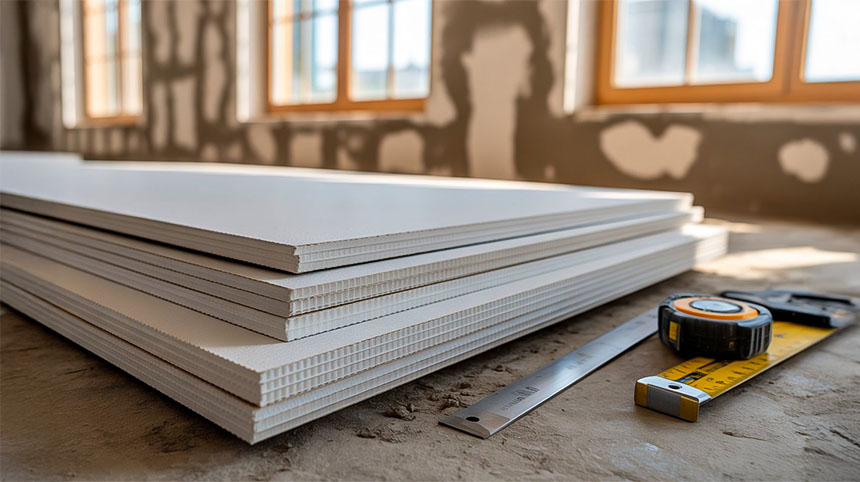
GCC Plasterboard Market to Reach 8.6 Million Tons by 2033 as Megaprojects and Fire Safety Regulations Reshape Demand

The GCC plasterboard market is undergoing a significant transformation. Traditionally influenced by construction volume cycles, the industry is now shifting towards a growth model that emphasizes specifications and compliance. According to the latest analysis by MarkSpark Solutions, regional plasterboard consumption reached 4.5 million tons in 2024 and is projected to grow to 8.6 million tons by 2033, reflecting a 7.0% compound annual growth rate (CAGR).
This growth is not solely driven by construction activity; it also reflects a clear shift toward fire-rated, moisture-resistant, and sustainability-certified plasterboard solutions across the Gulf Cooperation Council (GCC).
Access the full report here: https://marksparksolutions.com/reports/gcc-plasterboard-market
From Volume Growth to Specification-Driven Demand
Plasterboard, also known as gypsum board, has become an essential element in modern interior construction across Saudi Arabia, the UAE, Qatar, and other GCC markets. While the speed of installation is a significant advantage over traditional plaster systems, regulatory compliance and sustainability performance have become central criteria for purchasing decisions.
The growth of the plasterboard market closely aligns with national economic diversification programs, such as Saudi Vision 2030 and UAE Net Zero 2050. These initiatives are driving investments in tourism, residential communities, mixed-use developments, and large-scale infrastructure projects. Consequently, demand for plasterboard has emerged as a reliable indicator of growth in the non-oil sector across the Gulf region.
Regulatory Reform and Sustainability as Primary Growth Engines
Two forces are fundamentally reshaping the GCC plasterboard market:
- Fire Safety Regulations
Civil defense authorities in Saudi Arabia, the UAE, and Qatar are increasingly mandating fire-rated boards—particularly Type X glass-reinforced gypsum boards—in high-rise buildings, hospitals, commercial complexes, and hospitality developments. Fire-resistant plasterboard is no longer a premium add-on; it is becoming a baseline requirement. - Green Building Certification
Certification frameworks such as LEED, Estidama, and Mostadam are influencing procurement decisions. Developers are prioritizing low-VOC and recycled-content plasterboard to secure sustainability ratings that enhance property valuation and long-term asset performance.
Together, safety compliance and environmental mandates are structurally increasing demand for specialty plasterboard products across the GCC.
Download a free sample report:
https://marksparksolutions.com/sample-reports?312&Download_Free_Sample
Product Mix Evolution: Specialty Boards Gain Share
Although overall plasterboard volumes are rising, product composition is changing significantly:
- Standard Plasterboard: Holds 44.79% share but continues to decline from historical dominance.
- Fire-Resistant Boards: Account for 23.09%, supported by regulatory enforcement.
- Moisture-Resistant Boards: Represent 14.11%, driven by hospitality and residential applications.
- Acoustic Boards: 6.90%, expanding in commercial and mixed-use developments.
- Hybrid Fire-Moisture Boards: 8.11%, gaining traction in high-spec projects.
Specialty boards now account for over 55% of total demand, confirming a lasting shift away from commoditized, volume-based competition.
Pricing Dynamics and Margin Strategy
The GCC plasterboard market is experiencing cyclical pricing adjustments. After peaking at USD 420 per ton in 2025, average prices are expected to moderate to around USD 340 per ton by 2030, reflecting regional capacity expansion and improved logistics stability.
In this environment, profitability increasingly depends on:
- Premium product positioning
- Certification-backed differentiation
- Technical performance advantages
Volume growth alone is no longer sufficient to sustain margins.
Saudi Arabia Dominates Regional Demand
Saudi Arabia accounts for 60.15% of the GCC’s total plasterboard consumption, driven by major projects such as NEOM, The Red Sea Project, Roshn, and Qiddiya. The country’s strong domestic manufacturing capacity strengthens supply chain resilience and positions the Kingdom as a regional pricing benchmark.
The UAE holds a 22.09% market share, distinguished by a higher per-ton value due to stringent specifications and premium urban developments. Competitive Landscape: Certification Over Capacity
Market competition is increasingly shaped by product innovation and regulatory compliance. Regional leaders such as Mada Gypsum and Gypsemna leverage their local manufacturing scale. In contrast, global companies such as Knauf, Saint-Gobain Gyproc, and USG Zawawi Drywall compete through advanced research and development, extensive certifications, and specialized product offerings.
The strategic focus has shifted from merely expanding production capacity to providing performance-engineered solutions that comply with regulations.
Ask for a discount on the full report:
https://marksparksolutions.com/sample-reports?312&Ask_for_Discount
Outlook: A Decade Defined by Specification and Sustainability
The GCC plasterboard market is projected to grow at a compound annual growth rate (CAGR) of 7.0% through 2033, indicating strong structural momentum. However, the most significant opportunities for value creation will arise in specialty segments rather than in standard boards.
As fire safety standards tighten and sustainability requirements align with global benchmarks, high-performance gypsum boards are expected to capture a substantial market share. The future of the GCC plasterboard market will be defined not only by installation volume but also by performance quality.
Source: PR News Releaser