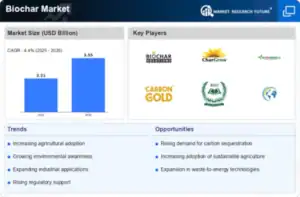

According to Market Research Future, biochar market is emerging as an important segment within sustainable agriculture, environmental management, and climate-focused solutions. Biochar is a carbon-rich material produced through the pyrolysis of organic biomass such as agricultural residues, forestry waste, and organic by-products under limited oxygen conditions. This process converts waste materials into a stable form of carbon that can be used to improve soil health, manage waste, and support long-term carbon sequestration.
Agriculture represents one of the key application areas driving the biochar market. When applied to soil, biochar helps improve soil structure, water retention, and nutrient availability, leading to better crop productivity and reduced fertilizer runoff. Its porous structure supports beneficial microbial activity and enhances soil resilience, particularly in degraded or nutrient-poor soils. As farmers and agricultural stakeholders seek sustainable practices to improve yields while reducing environmental impact, biochar adoption continues to grow.
Beyond agriculture, the biochar market is expanding into environmental and industrial applications. Biochar is increasingly used in water and wastewater treatment for filtration and adsorption of contaminants due to its high surface area. It is also being explored in construction materials, animal feed additives, and energy-related applications. Additionally, biochar plays a role in waste management by converting organic waste into valuable products, supporting circular economy initiatives and reducing landfill dependency.
Climate change mitigation is a significant factor supporting the growth of the biochar market. Biochar’s ability to store carbon in a stable form for long periods makes it an effective tool for reducing greenhouse gas emissions. Governments, research institutions, and private organizations are investing in biochar projects to support carbon removal strategies and sustainable land management. Advances in pyrolysis technology, scalability, and feedstock optimization are improving production efficiency and product consistency.
Despite challenges related to production costs and standardization, the biochar market shows strong growth potential. Increasing awareness of sustainable farming, soil regeneration, and carbon management is expected to drive wider adoption. As global focus on environmental sustainability intensifies, the biochar market is positioned to play a meaningful role in supporting resilient agriculture, cleaner ecosystems, and long-term climate goals.
Browse Related Reports: