

Introduction
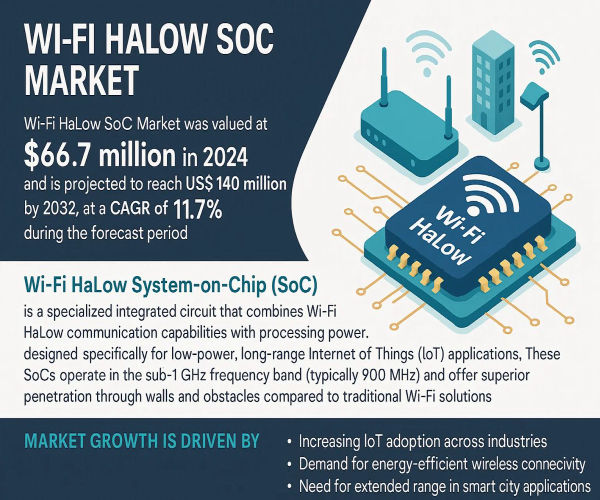
The Wi-Fi HaLow SoC market, valued at USD 66.7 million in 2024, is projected to reach USD 140 million by 2032, expanding at a strong CAGR of 11.7%. This fast-emerging semiconductor segment is becoming pivotal as industries accelerate toward long-range, low-power IoT connectivity.
𝐃𝐨𝐰𝐧𝐥𝐨𝐚𝐝 𝐅𝐑𝐄𝐄 𝐒𝐚𝐦𝐩𝐥𝐞 𝐑𝐞𝐩𝐨𝐫𝐭: https://semiconductorinsight.com/download-sample-report/?product_id=117894
Emerging Trends Shaping the Market
AI-Driven Chip Design Enhances Power Efficiency
AI-assisted SoC design is optimizing Wi-Fi HaLow chip architectures for lower latency and ultra-low power consumption. With IoT nodes expected to reach 29 billion by 2027, AI-enhanced SoCs enable longer battery life and improved spectral efficiency, amplifying HaLow’s suitability for remote sensors and large-scale deployments.
Advanced Lithography Techniques Improve Range and Performance
Next-generation lithography, including EUV-enabled processes, is refining the RF characteristics of HaLow SoCs. These improvements allow cleaner sub-1 GHz signal propagation, boosting coverage up to 1 km—a key requirement for industrial IoT systems and smart agricultural environments.
Growth of Compound Semiconductors Accelerates IoT Applications
While Wi-Fi HaLow SoCs primarily use CMOS, the broader shift toward SiC and GaN technologies is influencing adjacent components such as power management ICs. These advancements support more efficient IoT gateways and HaLow access points that must connect thousands of endpoints simultaneously.
3D Packaging and Heterogeneous Integration
3D chiplet architectures are enabling manufacturers to combine RF, baseband, and security modules in compact HaLow SoC designs. This modularity is driving adoption in space-constrained applications like wearables, healthcare devices, and smart meters.
Sustainability and Eco-Efficient Connectivity
As industries pursue energy-optimized infrastructures, Wi-Fi HaLow’s ability to consume up to 90% less power than traditional Wi-Fi positions it at the center of sustainable IoT rollouts, particularly for smart city projects requiring multi-year battery operation.
Key Market Drivers and Growth Factors
- Proliferation of IoT Devices: Surge toward billions of connected sensors boosts demand for long-range, low-power SoCs.
- Energy Efficiency Prioritization: HaLow devices extend battery life from hours to years, reducing maintenance in smart agriculture, industrial automation, and city infrastructure.
- Superior Penetration and Range: Sub-1 GHz operation supports reliable indoor/outdoor connectivity, solving coverage gaps inherent in conventional Wi-Fi.
- Smart City Expansion: Growing urbanization fuels deployment of HaLow-enabled lighting, surveillance, and monitoring systems.
- Industrial IoT Acceleration: Factories and logistics hubs increasingly rely on HaLow for robust machine-to-machine communication in challenging environments.
𝐆𝐞𝐭 𝐅𝐮𝐥𝐥 𝐑𝐞𝐩𝐨𝐫𝐭 𝐇𝐞𝐫𝐞: https://semiconductorinsight.com/report/wi-fi-halow-soc-market/
Strategic Developments by Key Players
Leading technology companies are rapidly expanding their Wi-Fi HaLow portfolios:
- Qualcomm Incorporated is integrating HaLow capabilities into broader IoT connectivity platforms to strengthen industrial and smart home offerings.
- Broadcom Inc. continues leveraging its wireless expertise to enhance RF performance and energy profiles within its HaLow chips.
- Newracom maintains an early-mover advantage with IEEE 802.11ah-based SoCs tailored for large-scale smart city installations.
- Morse Micro is scaling production of its MM6108 HaLow chip, partnering with Asian module makers to accelerate global adoption.
- MediaTek Inc. recently entered the market with energy-optimized solutions aimed at mass-market IoT devices.
- Newratek focuses on cost-efficient SoCs for consumer and industrial sectors.
- Taixin Semiconductor is strengthening its presence through low-cost HaLow solutions targeted at high-volume deployments.
These companies are advancing R&D, forming alliances, and deploying next-generation chipsets that expand the scope of HaLow-enabled applications.
Segment Analysis: Who Leads the Market?
By Type
- 2 MHz Bandwidth:
Holds a significant share due to ideal balance between energy efficiency and throughput, making it the leading choice for sensors, meters, and wearables. - 4 MHz Bandwidth:
Gains traction in higher-bandwidth uses such as security cameras, industrial monitors, and wireless audio devices. - Others:
Emerging configurations address niche or specialized IoT requirements.
By Application
- Industrial Automation dominates, driven by long-range connectivity needs for equipment monitoring and predictive maintenance.
- Smart Agriculture increasingly adopts HaLow for soil, weather, and livestock tracking.
- Smart Cities deploy HaLow for infrastructure management, traffic systems, and public safety networks.
- Smart Home & Healthcare see rising uptake in medical wearables and home automation systems.
By End User
The industrial sector holds the largest share due to widespread IoT integration, followed by municipal authorities, healthcare, consumer electronics, and agricultural enterprises.
𝐃𝐨𝐰𝐧𝐥𝐨𝐚𝐝 𝐅𝐑𝐄𝐄 𝐒𝐚𝐦𝐩𝐥𝐞 𝐑𝐞𝐩𝐨𝐫𝐭: https://semiconductorinsight.com/download-sample-report/?product_id=117894
Technological Advancements Impacting Growth
Can AI-Driven Lithography Redefine Semiconductor Yield Rates?
AI-assisted lithography is enhancing production accuracy for complex RF structures required in HaLow SoCs, improving yields and lowering manufacturing costs.
Nanofabrication and Cleanroom Automation
Advanced nanofabrication ensures higher consistency in RF module design, leading to better long-range performance. Automated cleanrooms are also reducing defect rates in high-volume HaLow SoC manufacturing.
Integration of Edge AI
Embedding lightweight edge-AI accelerators in HaLow SoCs enables on-device decision-making, critical for industrial robotics, environmental sensing, and healthcare monitoring.
Why This Report Matters
This market report delivers deep insights across 2024–2032, offering precise growth estimations, competitive intelligence, technology evaluations, and evolving opportunity landscapes. Stakeholders gain actionable data to strategize investment, product development, and go-to-market plans in a rapidly scaling connectivity ecosystem.
𝐆𝐞𝐭 𝐅𝐮𝐥𝐥 𝐑𝐞𝐩𝐨𝐫𝐭 𝐇𝐞𝐫𝐞: https://semiconductorinsight.com/report/wi-fi-halow-soc-market/
𝐂𝐨𝐧𝐜𝐥𝐮𝐬𝐢𝐨𝐧
As IoT ecosystems expand across industries, Wi-Fi HaLow is emerging as one of the most transformative connectivity technologies. As the semiconductor landscape evolves at record speed, stakeholders must align innovation with sustainability and strategic foresight to remain competitive.
Contact Us:
🌐 Website: https://semiconductorinsight.com/
📞 International: +91 8087 99 2013
🔗 LinkedIn: Follow Us
Source: PR News Releaser
