

Introduction
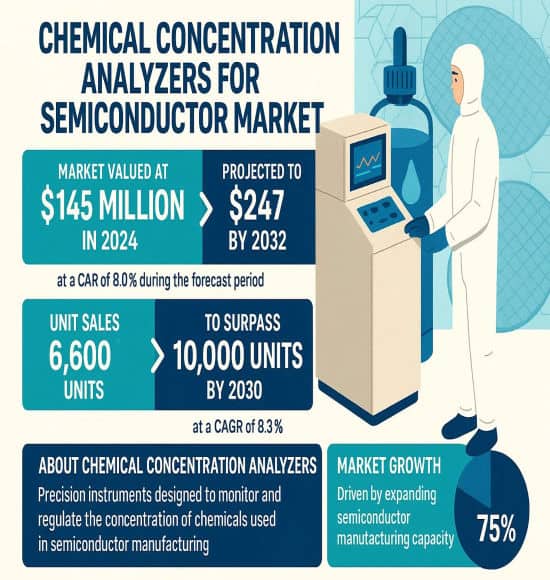
The Chemical Concentration Analyzers for Semiconductor market was valued at US$145 million in 2024 and is forecast to reach US$ 247 million by 2032, reflecting an 8.0% CAGR through the projection window. As fabs race toward 3nm and 2nm nodes and cleanroom automation becomes the norm, real-time chemical monitoring has shifted from quality support to a core production control element. The semiconductor industry continues to redefine global innovation, with this market showing robust expansion and technological disruption.
𝐃𝐨𝐰𝐧𝐥𝐨𝐚𝐝 𝐅𝐑𝐄𝐄 𝐒𝐚𝐦𝐩𝐥𝐞 𝐑𝐞𝐩𝐨𝐫𝐭: https://semiconductorinsight.com/download-sample-report/?product_id=117724
Emerging Trends Shaping the Market
- AI-Driven Process Optimization Machine learning models now consume concentration data streams to predict drift and trigger autonomous corrective actions, shrinking chemical-related yield losses.
• Advanced Lithography and EUV Sensitivity As feature sizes tighten, even slight chemical variances affect critical dimensions, elevating demand for sub-ppm measurement accuracy.
• Rise of Compound Semiconductors SiC and GaN manufacturing introduce new chemistries and harsher process windows, driving adoption of specialized analyzer technologies.
• 3D Packaging and Through-Silicon Demands — New packaging approaches require tighter control of cleaning and etch chemistries across stacked dies.
• Sustainability and Waste Minimization Stricter environmental rules and circular-economy initiatives are increasing focus on precise chemical usage and effluent reduction.
Each of these trends directly increases reliance on inline, contactless, and IoT-enabled analyzers that can report precise concentrations without interrupting high-volume production lines.
Key Market Drivers and Growth Factors
- Surging semiconductor demand — High performance computing, AI inference servers, and memory growth expand fab throughput, requiring robust chemical control.
• Node-shrink sensitivity — Transition to 3nm/2nm processes has made concentration tolerance tighter by an estimated ~40%, increasing analyzer necessity.
• Smart factory integration — Over 80% of 2024 analyzer sales included industrial IoT connectivity, enabling MES integration and predictive maintenance.
• Regulatory pressure — Tighter environmental and waste-management standards make accurate monitoring both an operational and compliance imperative.
• Foundry and IDM investments — New fab capacity and domestic production initiatives in the U.S. and Europe create fresh demand beyond Asia-Pacific.
𝐆𝐞𝐭 𝐅𝐮𝐥𝐥 𝐑𝐞𝐩𝐨𝐫𝐭 𝐇𝐞𝐫𝐞: https://semiconductorinsight.com/report/chemical-concentration-analyzers-for-semiconductor-market/
Strategic Developments by Key Players
Leading companies are expanding through R&D, acquisitions, and solution bundling:
• HORIBA, Ltd. (Japan) — Strengthened market leadership with advanced laser-based measurement rollouts.
• KURABO INDUSTRIES LTD. (Japan) — Focused on ultrasonic solutions calibrated for wet process control.
• Fuji Ultrasonic Engineering Co., Ltd. (Japan) — Continued refinement of non-invasive analyzers for in-line monitoring.
• Entegris, Inc. (U.S.) — Integrated concentration analysis into chemical delivery systems following a sensor-tech acquisition.
• ABB Ltd. (Switzerland) — Moving toward system-level automation and MES connectivity.
• SensoTech GmbH (Germany) and Rhosonics BV (Netherlands) — Targeting niche nodes and specialty chemistries with compact inline units.
• PIMACS Pte. Ltd. (Singapore) and CI Semi (Israel) — Emerging entrants focused on ruggedized, fab-grade sensors.
These moves show a pattern: technical specialization plus platform integration to meet foundry demands.
Segment Analysis: Who Leads the Market?
Contactless types (ultrasonic, optical) dominate due to non-invasive measurement and minimal contamination risk, with ultrasonic technology gaining particular traction for real-time monitoring. By application, semiconductor cleaning — including SC1 and SC2 processes — accounts for the largest share because of its sensitivity to concentration drift. Regionally, Asia-Pacific leads consumption, driven by major capacity in China, Taiwan, South Korea and Japan, while Japan supplies the majority of analyzer production. Foundries represent the largest end-user segment, followed by IDMs and research institutes.
𝐃𝐨𝐰𝐧𝐥𝐨𝐚𝐝 𝐅𝐑𝐄𝐄 𝐒𝐚𝐦𝐩𝐥𝐞 𝐑𝐞𝐩𝐨𝐫𝐭: https://semiconductorinsight.com/download-sample-report/?product_id=117724
Technological Advancements Impacting Growth
Can AI-driven lithography and analytics redefine yield rates? Modern analyzers feed high-frequency process data into AI models that optimize chemistry setpoints and schedule preventive maintenance, directly improving wafer yields. Nanofabrication demands, MES linkage, and predictive analytics are converging to make analyzers a strategic process control asset rather than a standalone instrument.
Why This Report Matters
This report gives stakeholders actionable market sizing (2024–2032), competitive intelligence, and technology roadmaps necessary for procurement, R&D prioritization, and strategic partnerships. It maps emerging opportunities created by node transitions, identifies regions with rising demand, and highlights which technology approaches — ultrasonic, optical, contactless — are winning in production environments.
𝐆𝐞𝐭 𝐅𝐮𝐥𝐥 𝐑𝐞𝐩𝐨𝐫𝐭 𝐇𝐞𝐫𝐞: https://semiconductorinsight.com/report/chemical-concentration-analyzers-for-semiconductor-market/
Conclusion
As semiconductor manufacturing accelerates toward smaller nodes, higher throughput and stricter environmental controls, chemical concentration analyzers will become indispensable instruments of both productivity and compliance. Stakeholders who align product development, supply chains, and fab integration strategies with these trends will be best positioned to harness the market’s growth.
Explore the full report for in-depth forecasts, company profiles, and technology analyses at [Your Website Name].
Contact Us:
🌐 Website: https://semiconductorinsight.com/
📞 International: +91 8087 99 2013
🔗 LinkedIn: Follow Us
Source: PR News Releaser
